

RCM billing is the end-to-end process healthcare organizations use to capture, bill, collect, and reconcile revenue from patient care. It begins with patient registration and insurance verification and continues through coding, claim submission, payment posting, denial management, accounts receivable follow-up, and final payment.
For U.S. healthcare practices, effective RCM billing is no longer simply a back-office function. It connects clinical documentation, payer requirements, patient access, medical billing, coding, denials, and financial reporting into one coordinated revenue cycle.
That matters because a problem early in the process can create a financial problem much later.
Incorrect insurance information can become a denied claim. Missing authorization can delay reimbursement. Coding errors can create payer rework, while weak A/R follow-up can leave valid claims unpaid.
BillingMate provides medical billing services that connect eligibility, coding, claim submission, payment posting, denial management, and A/R follow-up within a broader revenue cycle workflow.

What Does RCM Mean in Medical Billing?
RCM stands for Revenue Cycle Management.
In healthcare, revenue cycle management covers the financial journey of a patient encounter from the first administrative interaction through final payment.
A typical healthcare revenue cycle includes:
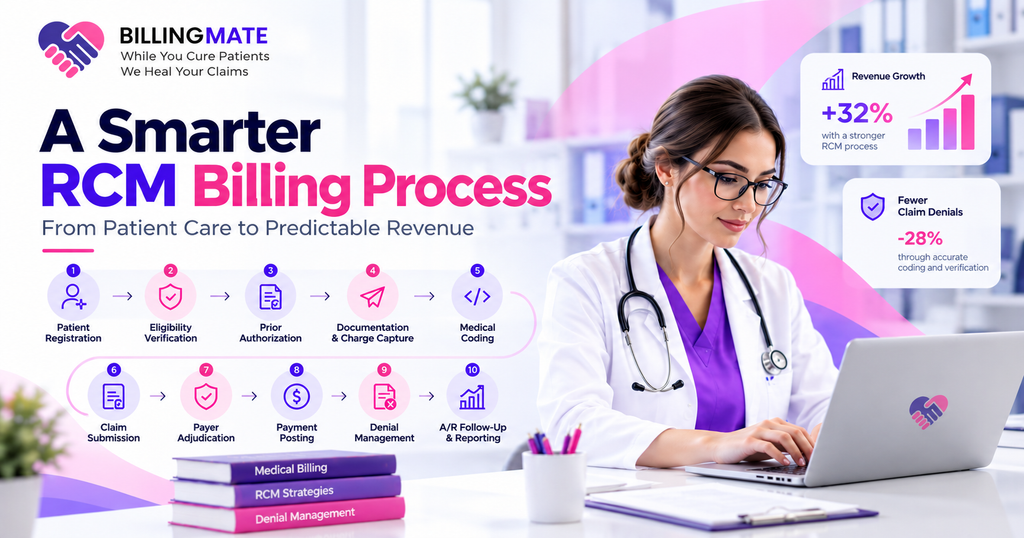
Registration → Eligibility → Authorization → Documentation → Coding → Claim Submission → Adjudication → Payment Posting → Denial Management → A/R Follow-Up
This means medical billing is an important part of RCM, but the two terms are not exactly the same.
RCM Billing vs. Medical Billing
| Medical Billing | Revenue Cycle Management |
| Focuses mainly on claims and reimbursement | Covers the complete financial workflow |
| Includes claim preparation and submission | Begins before the patient receives care |
| Handles payer responses | Includes eligibility and authorization |
| Includes denials and payment posting | Includes coding, claims, A/R and reporting |
| Often viewed as back-office work | Connects front, middle and back-office functions |
A medical claim may be prepared perfectly and still encounter problems if something earlier in the revenue cycle was incorrect.
That is why strong healthcare revenue cycle management looks at the entire process.
Why Is RCM Billing Important in 2026?
Revenue cycle management is becoming more strategically important for U.S. healthcare organizations as payer requirements, staffing pressures, reimbursement complexity, and technology continue to change.
McKinsey’s 2026 healthcare RCM research describes revenue cycle management as moving beyond a traditional back-office cost function toward a broader strategic role connecting administrative, clinical, financial, and technological processes.
At the same time, healthcare organizations are increasingly using automation and AI in areas such as eligibility verification, patient access, claims, and denial prevention—but human oversight remains important for complex decisions and exceptions.
For a healthcare practice, the practical goal remains simple:
Prevent avoidable errors, submit accurate claims, follow unresolved balances, and understand where revenue is being delayed.
The 10 Steps of the RCM Billing Process
1. Patient Registration
The revenue cycle begins before billing.
During registration, the practice collects information such as:
- Patient name
- Date of birth
- Address
- Contact information
- Insurance details
- Subscriber information
- Primary and secondary coverage
This information eventually appears on the claim.
A small registration error may therefore create a large billing problem later.
Incorrect member IDs, outdated insurance information, or inaccurate demographics can lead to claim rejections and additional staff work.
2. Eligibility and Benefits Verification
Insurance verification helps determine whether the patient’s coverage is active and what benefits apply to the planned service.
Practices may need to verify:
- Coverage status
- Effective dates
- Copay
- Deductible
- Coinsurance
- Plan type
- Referral requirements
- Prior authorization requirements
Many downstream revenue cycle problems begin with inaccurate patient data or inefficient intake workflows.
That makes eligibility verification one of the most important front-end RCM controls.
3. Prior Authorization
Certain services require payer approval before they are delivered.
Depending on the plan and service, authorization may apply to:
- Imaging
- Procedures
- Surgery
- Specialty medications
- Therapy
- Infusion services
- Diagnostic testing
The authorization should match the:
Patient + Provider + Procedure + Location + Date + Approved Units
A mismatch can later become a denial.
Prior authorization should therefore be connected with scheduling, coding, clinical documentation, and billing rather than handled as a completely separate administrative task.
4. Clinical Documentation and Charge Capture
Once care has been provided, the medical record needs to support the services performed.
Documentation may include:
- Diagnosis
- Clinical findings
- Treatment
- Procedures
- Medical necessity
- Provider notes
Accurate charge capture ensures that documented services are transferred correctly into the billing workflow.
Missing charges can result in lost revenue.
Unsupported charges can create compliance or payer issues.
The goal is:
Capture every appropriate service—but only what the documentation supports.
5. Medical Coding
Medical coding converts documented healthcare services into standardized codes.
Common code sets include:
- CPT
- ICD-10-CM
- HCPCS
- Modifiers
Coding affects claim accuracy, reimbursement, payer processing, and denial risk.
BillingMate’s medical coding services support CPT, ICD-10-CM, HCPCS, modifiers, and specialty-specific coding workflows based on available clinical documentation and payer requirements.
Coding should also be connected with denial data.
If one coding issue repeatedly causes denials, fixing individual claims without correcting the coding workflow will not solve the underlying problem.
6. Claim Scrubbing and Submission
Before claims are sent to the payer, they should be checked for errors.
Claim scrubbing can identify issues such as:
- Missing fields
- Invalid codes
- Insurance errors
- Modifier problems
- Provider information
- Authorization inconsistencies
- Formatting problems
BillingMate currently describes claim scrubbing and submission as part of its broader RCM service structure, including payer-specific validation and electronic submission workflows.
Once the claim passes review, it can be submitted electronically through the appropriate payer or clearinghouse workflow.
The objective is not simply fast submission.
It is:
Fast + Accurate + Trackable Submission
7. Payer Adjudication
After the payer receives the claim, it evaluates the submission.
The payer may review:
- Eligibility
- Benefits
- Coding
- Medical necessity
- Provider enrollment
- Prior authorization
- Contract terms
The claim may then be:
Paid
Partially paid
Denied
Rejected
Pending
Returned for additional information
Practices should monitor claim status rather than assuming that a successfully transmitted claim will automatically result in payment.
8. Payment Posting and Reconciliation
When a payer processes the claim, the payment and adjustment information needs to be posted correctly.
Payment posting may include:
- Insurance payments
- Contractual adjustments
- Copays
- Deductibles
- Coinsurance
- Denial codes
- Patient responsibility
But posting alone is not enough.
Payments should also be reconciled.
If the expected reimbursement differs from the actual amount received, the practice may need to investigate whether the difference represents:
- Contractual adjustment
- Underpayment
- Denial
- Posting error
- Secondary insurance responsibility
- Patient responsibility
BillingMate’s service structure includes payment posting and reconciliation as part of its broader revenue cycle workflow.
9. Denial Management
A denied claim should never be treated simply as an isolated problem.
The first question should be:
Why was this claim denied?
Common causes include:
- Eligibility
- Authorization
- Coding
- Documentation
- Medical necessity
- Provider enrollment
- Timely filing
- Duplicate billing
- Coordination of benefits
Effective denial management follows:
Identify → Correct → Resubmit/Appeal → Track → Analyze → Prevent
For example:
Eligibility denial → Review registration and verification
Authorization denial → Review prior authorization workflow
Coding denial → Review coding and documentation
Credentialing denial → Review payer enrollment
The real value of denial management comes from preventing the same problem from repeating.
10. Accounts Receivable Follow-Up and Reporting
A claim that has not been paid still needs active management.
Medical billing A/R is commonly grouped into aging buckets:
- 0–30 days
- 31–60 days
- 61–90 days
- 91–120 days
- 120+ days
Older claims generally require more investigation.
A structured A/R workflow should answer:
What is the claim status?
Why is it unpaid?
What action is required?
Who owns the account?
When is the next follow-up?
BillingMate’s medical billing service includes denial management and accounts receivable follow-up within the same full-cycle billing workflow.
Where Does RCM Revenue Usually Get Delayed?
Revenue cycle problems can occur anywhere in the workflow.
But several issues appear repeatedly.
Incorrect Patient Information
Registration errors may prevent a claim from processing correctly.
Eligibility Problems
The patient’s policy may be inactive, changed, or incorrectly recorded.
Missing Prior Authorization
Services requiring advance approval may be denied when authorization is missing or incorrect.
Coding Errors
Incorrect or unsupported codes can delay reimbursement.
Claim Submission Errors
Missing information may result in rejection before payer adjudication.
Provider Credentialing Problems
Claims may encounter reimbursement issues when payer enrollment is incomplete or outdated.
BillingMate’s provider credentialing services support payer enrollment, CAQH maintenance, follow-up, and recredentialing workflows.
Unresolved Denials
Denied claims that are not worked promptly move deeper into A/R.
Payment Posting Errors
Incorrect posting can make paid claims appear outstanding or hide underpayments.
What RCM Metrics Should Healthcare Practices Track?
A strong RCM program needs measurable performance.
Practices may monitor:
Clean Claim Performance
How many claims pass initial review without avoidable errors?
Rejection Rate
How many claims fail before normal payer adjudication?
Denial Rate
How many payer-processed claims are denied?
Days in A/R
How long does revenue remain outstanding?
A/R Aging
How much receivable sits in 30, 60, 90, or 120+ day buckets?
Payment Posting Accuracy
Are payer payments and adjustments being posted correctly?
Underpayments
Are payers reimbursing according to expected terms?
Authorization-Related Denials
How many claims fail because prior authorization was missing or incorrect?
Eligibility-Related Denials
How many claims trace back to patient coverage problems?
No single KPI tells the entire story.
Patterns across multiple metrics usually provide a clearer view of revenue cycle performance.
How Can U.S. Healthcare Practices Improve RCM Billing?
Practices do not necessarily need to overhaul every part of their revenue cycle at once.
Start by identifying where problems are entering the workflow.
Improve Front-End Data
Accurate patient demographics and insurance information reduce downstream rework.
Verify Eligibility Early
Identify coverage problems before treatment.
Track Authorization
Every required authorization should have a status, owner, approval period, and reference number.
Connect Documentation With Coding
Coders should have access to clear documentation supporting billed services.
Scrub Claims Before Submission
Prevent avoidable errors from reaching payers.
Categorize Denials
Do not keep all denials in one generic queue.
Work A/R Consistently
Every unpaid claim should have a next action.
Reconcile Payments
Identify underpayments and posting discrepancies rather than assuming payment equals resolution.
Review Performance Regularly
Use data to determine which payer, service, provider, or workflow is creating repeated problems.
When Should a Practice Consider an RCM Audit?
A revenue cycle review may be useful when a healthcare practice experiences:
- Increasing denials
- Rising A/R
- Declining collections
- Repeated coding errors
- Payment posting discrepancies
- High rejection volume
- Authorization issues
- Underpayments
- Provider enrollment delays
BillingMate’s medical billing audit services are designed to review claims, coding, documentation, denials, payments, and aging A/R to identify recurring workflow problems and potential revenue leakage.
An audit should answer:
What is happening?
Where is it happening?
Why is it happening?
What workflow should change?
In-House RCM vs. Outsourced RCM Services
There is no single model that fits every healthcare practice.
Some organizations maintain a fully in-house team.
Others use outsourced revenue cycle management services.
Some use a hybrid approach.
The decision should consider:
- Practice size
- Specialty
- Claim volume
- Staff capacity
- Payer mix
- Denial workload
- A/R aging
- Technology
- Reporting requirements
- Growth plans
Practices considering an RCM partner should ask specific operational questions.
Who verifies eligibility?
Who handles coding?
How are claims scrubbed?
How quickly are rejected claims worked?
Who manages denials?
How is A/R prioritized?
How are payments reconciled?
What reporting will the practice receive?
The strongest RCM relationship is one where responsibilities are clear and performance remains visible.
What Does BillingMate Include in RCM Billing?
BillingMate’s current service model covers major stages of the revenue cycle, including:
- Eligibility and benefits verification
- Medical coding
- Claim scrubbing
- Claim submission
- Payment posting
- Denial management
- A/R follow-up
- Provider credentialing
- Reporting and audits
BillingMate describes its medical billing offering as a full-cycle workflow designed to connect these functions through one accountable billing team.
That connected structure matters because revenue-cycle problems rarely stay within one department.
An eligibility mistake may eventually appear as a denial.
A coding issue may eventually become aging A/R.
A credentialing issue may look like a claims problem.
Effective RCM helps identify the source, not just the symptom.
Frequently Asked Questions About RCM Billing
What is RCM billing in healthcare?
RCM billing is the complete financial process used to manage revenue from patient care, including registration, eligibility verification, authorization, coding, claims, payments, denials, and accounts receivable.
What does RCM stand for in medical billing?
RCM stands for Revenue Cycle Management.
Is RCM the same as medical billing?
No. Medical billing is one part of revenue cycle management. RCM covers the broader financial workflow from patient registration through final payment.
What are the main stages of revenue cycle management?
The main stages include patient registration, insurance verification, prior authorization, documentation, coding, claim submission, payer adjudication, payment posting, denial management, and A/R follow-up.
Why is RCM important for healthcare practices?
RCM helps healthcare practices manage reimbursement more systematically, identify billing problems earlier, monitor unpaid claims, and understand where revenue is being delayed.
What causes revenue cycle problems?
Common causes include inaccurate patient information, eligibility errors, authorization issues, coding mistakes, claim rejections, denials, credentialing problems, underpayments, and weak A/R follow-up.
What is A/R in RCM?
A/R means accounts receivable—the money still owed to a healthcare organization for services already provided.
Can healthcare practices outsource RCM billing?
Yes. Some practices outsource part or all of the revenue cycle, including coding, claim submission, denial management, payment posting, credentialing, and A/R follow-up.
Final Thoughts
RCM billing is not one billing task. It is the complete financial workflow surrounding patient care.
A strong revenue cycle connects:
Registration → Eligibility → Authorization → Documentation → Coding → Claims → Payments → Denials → A/R → Reporting
When these stages operate separately, information can be lost between departments.
When they operate as one connected system, healthcare practices have a clearer view of where claims are delayed, why denials occur, and which workflows require improvement.
For U.S. healthcare organizations, the objective of revenue cycle management billing should therefore go beyond submitting more claims.