
Healthcare practices are under constant pressure to balance patient care with the administrative work required to get paid accurately and on time.
Every patient encounter creates a chain of revenue-cycle tasks: insurance verification, prior authorization, documentation, medical coding, claim preparation, claim submission, payment posting, denial management, accounts receivable follow-up, and reporting.
When that workload becomes difficult to manage internally, practice leaders often face an important question:
Should we continue managing billing in-house, or should we outsource medical billing services?
The answer depends on the practice. But understanding the benefits of outsourcing medical billing can help physicians, practice managers, and healthcare organizations make a more informed decision.
Quick Answer: What Are the Main Benefits of Outsourcing Medical Billing?
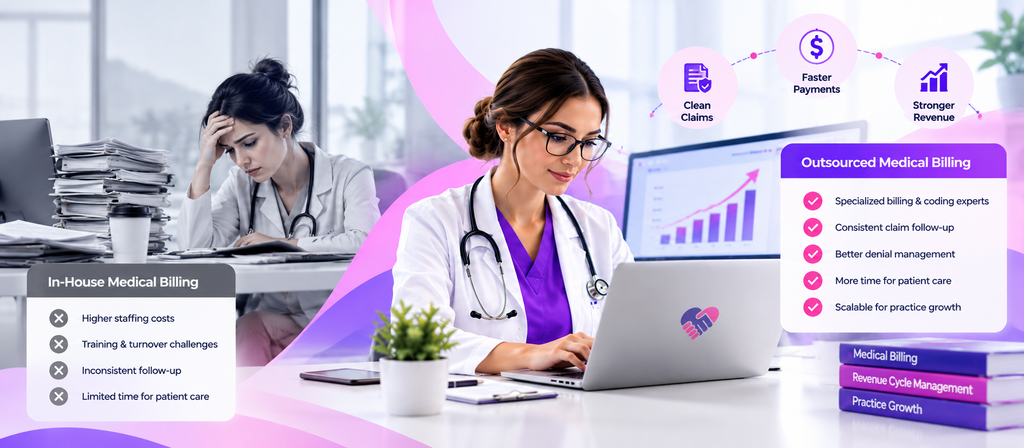
The main potential benefits of outsourcing medical billing include:
- Reduced internal billing workload
- Access to specialized billing and coding expertise
- More consistent claim follow-up
- Structured denial management
- Better A/R visibility
- Reduced dependence on individual staff members
- Easier scalability as the practice grows
- More predictable billing operations
- Access to dedicated revenue-cycle reporting
- Less administrative pressure on clinical and front-office teams
Outsourcing does not automatically guarantee higher collections or fewer denials. Results depend on the billing partner, specialty, payer mix, practice workflows, documentation quality, and how clearly responsibilities are defined.
The real advantage of outsourcing is usually operational consistency.
What Is Outsourced Medical Billing?
Outsourced medical billing means a healthcare practice contracts with an external company to manage some or all of its billing and revenue-cycle functions.
Depending on the arrangement, an outsourced billing team may handle:
- Insurance eligibility verification
- Prior authorization support
- Charge entry
- Medical coding
- Claim scrubbing
- Claim submission
- Payment posting
- Denial management
- A/R follow-up
- Payment reconciliation
- Provider credentialing
- Reporting
- Billing audits
BillingMate currently positions its services around full-cycle billing and revenue-cycle support for U.S. healthcare practices.
Practices evaluating external support can review BillingMate’s medical billing services as part of that comparison.
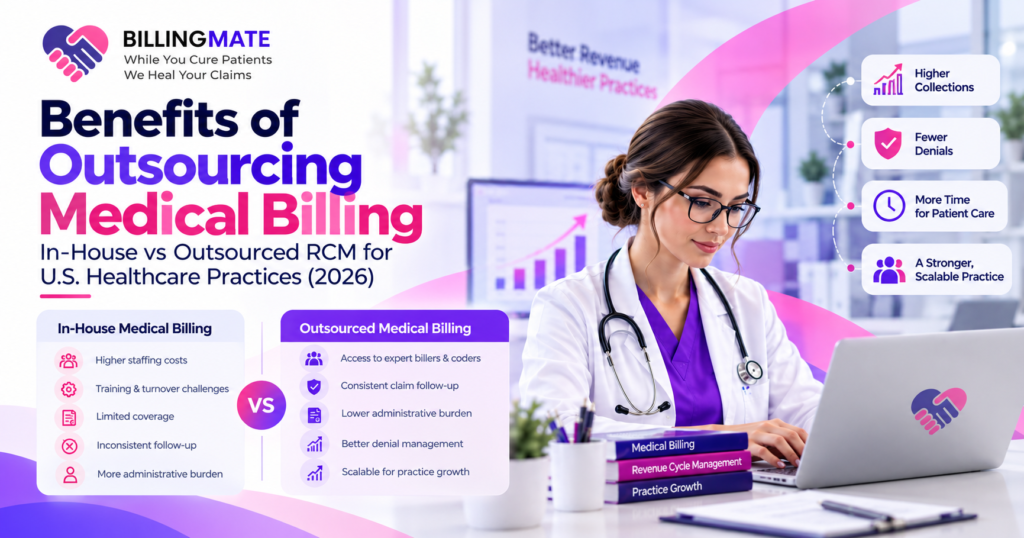
In-House vs Outsourced Medical Billing: What Is the Difference?
The biggest difference is who owns the day-to-day billing operation.
| Area | In-House Medical Billing | Outsourced Medical Billing |
| Staffing | Practice hires and manages staff | Billing partner provides staff |
| Training | Practice responsibility | Vendor responsibility |
| Turnover risk | Directly affects practice | Absorbed partly by vendor |
| Coding expertise | Depends on internal team | May include dedicated coders |
| Denial follow-up | Internal workload | Managed externally |
| A/R follow-up | Internal workload | Can be included |
| Technology | Practice manages tools | Vendor often works within existing systems |
| Reporting | Built internally | Often standardized |
| Scalability | May require new hires | Typically easier to expand |
| Management time | Higher | Usually lower |
| Control | Direct | Shared through service agreement |
Neither model is automatically better.
The right choice depends on the practice’s size, specialty, claim volume, payer mix, staffing situation, technology, and financial goals.
Why Healthcare Practices Consider Outsourcing Medical Billing
Most practices do not outsource billing because of one isolated issue.
Usually, several operational problems begin appearing at the same time.
Common signs include:
- Denial volume increasing
- A/R getting older
- Claim submission becoming inconsistent
- Billing staff turnover
- Coding backlogs
- Payment posting delays
- Eligibility errors
- Limited reporting
- New providers joining the practice
- Practice expansion
- Leadership spending too much time supervising billing
When these issues begin affecting daily operations, revenue cycle management outsourcing may become worth evaluating.
1. Lower Dependence on Internal Billing Staff
An internal billing department depends heavily on people.
When an experienced biller leaves, the practice may suddenly lose knowledge about:
- Payers
- Denial workflows
- Coding patterns
- EHR processes
- A/R accounts
- Provider enrollment
- Appeal deadlines
Recruiting and training a replacement takes time.
During that transition, claims still need to be submitted and followed.
One of the practical benefits of outsourcing medical billing is reducing reliance on a small number of internal employees.
A billing partner can provide broader team coverage instead of placing the complete revenue cycle on one or two staff members.
2. More Consistent Medical Billing Workflows
Billing performance often suffers when processes depend on individual habits rather than documented workflows.
For example:
Biller A may work denials daily.
Biller B may review them weekly.
Biller C may focus primarily on new claims and leave older A/R for later.
An outsourced medical billing company should ideally establish clear workflows for:
Eligibility → Coding → Claim Review → Submission → Payment Posting → Denials → A/R Follow-Up
Consistency matters because medical billing problems compound over time.
A rejected claim that is not corrected quickly can become an aging balance.
A denial that is not categorized may continue repeating across future claims.
3. Access to Specialized Medical Billing and Coding Expertise
Healthcare billing is not one generic administrative process.
Different specialties may have different:
- CPT patterns
- Documentation requirements
- Modifiers
- Authorization rules
- Payer policies
- Common denial reasons
That makes specialty awareness important.
An outsourced billing provider may give practice access to billers and coders who work across these areas more regularly than a small internal team.
For practices that need coding support alongside billing, BillingMate also provides medical coding services.
A stronger model connects coding feedback with denial management.
If the same coding issue repeatedly causes claims to be denied, the solution should not be limited to correcting individual claims.
The coding workflow itself should be reviewed.
4. Better Denial Management
Denied claims require time.
The billing team must:
- Identify the denial reason.
- Review the claim.
- Review payer requirements.
- Gather documentation.
- Correct errors.
- Resubmit or appeal where appropriate.
- Track the outcome.
But the more important question is:
Why did the denial happen in the first place?
Common causes include:
- Eligibility errors
- Missing prior authorization
- Coding issues
- Documentation gaps
- Credentialing problems
- Medical necessity
- Duplicate claims
- Timely filing
Effective denial management services should therefore focus on both correction and prevention.
A strong process is:
Identify → Correct → Track → Analyze → Prevent
When recurring denial causes are visible, practices can correct the upstream workflow creating them.
5. More Structured A/R Follow-Up
Accounts receivable can become difficult to manage when claim volume grows.
A/R is commonly divided into aging buckets such as:
- 0–30 days
- 31–60 days
- 61–90 days
- 91–120 days
- 120+ days
Not every unpaid claim should be handled the same way.
A strong A/R process prioritizes balances based on:
- Claim age
- Dollar value
- Payer
- Denial reason
- Appeal deadline
- Filing limit
- Previous follow-up
- Recoverability
Outsourced RCM services for healthcare practices can provide a more structured follow-up process when internal teams do not have enough capacity to manage older accounts consistently.
6. Reduced Administrative Burden on Practice Staff
Front-office and clinical staff already manage:
- Scheduling
- Patient communication
- Documentation
- Referrals
- Prior authorization
- Records
- Provider requests
When billing problems constantly return to these same employees, administrative pressure increases.
Outsourcing billing can allow internal staff to focus more on tasks that require direct practice involvement.
This does not mean the practice completely disengages from billing.
The strongest model is collaborative.
The billing partner manages routine revenue-cycle functions while practice leadership retains visibility and control.
7. Easier Scalability for Growing Practices
Practice growth can quickly increase billing complexity.
Growth may include:
- More providers
- New specialties
- Additional locations
- Higher patient volume
- More claims
- New payer contracts
An in-house department may need additional hiring every time volume increases.
An outsourced team can often scale resources more easily.
This makes outsourcing particularly relevant for growing physician groups, multi-location practices, and organizations onboarding new providers.
8. Improved Revenue Cycle Visibility
A common concern about outsourcing is:
“Will we lose control of our billing?”
A good outsourcing relationship should actually provide more visibility, not less.
Practice leadership should be able to monitor:
- Claims submitted
- Claims paid
- Denials
- Rejections
- A/R aging
- Payer trends
- Payment activity
- Outstanding balances
Outsourcing should never turn revenue cycle management into a black box.
A qualified billing partner should clearly explain what is happening with the practice’s claims and why.
9. Better Payment Posting and Reconciliation
Payment posting is easy to underestimate.
A payment may arrive, but that does not automatically mean the account is resolved correctly.
The team needs to review:
- Insurance payment
- Patient responsibility
- Contractual adjustments
- Denial codes
- Remark codes
- Secondary payer responsibility
- Remaining balances
Payment reconciliation can also reveal:
- Underpayments
- Incorrect adjustments
- Missing payments
- Posting errors
An outsourced RCM provider with structured posting and reconciliation workflows can help maintain more accurate A/R data.
10. Reduced Technology and Training Burden
Medical billing teams need to keep up with:
- EHR workflows
- Clearinghouses
- Claim rules
- Coding updates
- Payer portals
- Reporting systems
An internal department requires ongoing training and supervision.
Outsourcing shifts part of that operational responsibility to the billing partner.
However, healthcare practices should still confirm that a vendor can work effectively with their existing technology.
BillingMate currently states that it can work with existing practice systems rather than requiring every practice to migrate to a completely new EHR environment.
11. More Predictable Billing Costs
Internal billing has several cost components:
- Salaries
- Benefits
- Recruitment
- Training
- Software
- Clearinghouse costs
- Management
- Staff turnover
Outsourced billing is commonly priced using models such as:
- Percentage of collections
- Fixed monthly fee
- Per-claim pricing
- Hybrid arrangements
The cheapest pricing model is not automatically the best.
Practices should compare:
Total Cost + Service Scope + Accountability + Reporting + Expertise
rather than comparing percentages alone.
BillingMate currently publishes a percentage-based pricing example on its website, but actual costs should be confirmed directly because pricing can depend on the practice and service scope.
12. Better Support During Practice Growth or Transition
Outsourcing can also be useful during operational changes.
Examples include:
- Opening a new location
- Adding providers
- Changing billing staff
- Switching systems
- Cleaning up old A/R
- Recovering from a billing backlog
A practice does not necessarily need to wait until the revenue cycle is performing poorly.
Outsourcing can be used proactively when growth is expected to create more billing workload than the existing team can handle.
What Are the Disadvantages of Outsourcing Medical Billing?
A balanced decision also needs to consider potential disadvantages.
Less Direct Daily Control
The practice no longer manages every biller directly.
This makes communication standards important.
Vendor Quality Can Vary
Not every medical billing outsourcing company uses the same processes.
Practices should evaluate the provider carefully.
Transition Period
Moving from one billing model to another requires coordination.
Data access, workflows, responsibilities, reporting, and old A/R need to be addressed.
Communication Problems Can Create Delays
If clinical staff and the billing team do not communicate clearly, outsourcing alone will not fix workflow gaps.
Privacy and Security Responsibilities Still Matter
Medical billing companies may qualify as business associates when they create, receive, maintain, or transmit PHI on behalf of covered entities. HHS specifically lists billing and claims processing among activities that can make an organization a business associate. Covered entities generally need an appropriate business associate agreement and safeguards for PHI.
This means practices should evaluate privacy, security, access controls, and contractual responsibilities when selecting an outsourced billing partner.
HIPAA and Outsourced Medical Billing
When an external billing company handles protected health information, HIPAA considerations become important.
HHS states that billing companies can be business associates when they perform billing or claims-related functions involving PHI.
Healthcare practices should therefore confirm:
- Business Associate Agreement
- PHI safeguards
- Access controls
- Workforce training
- Secure data handling
- Subcontractor responsibilities
- Incident procedures
Outsourcing the work does not eliminate the practice’s responsibility to choose vendors appropriately.
When Should a Practice Keep Billing In-House?
In-house billing may still be the right choice when:
- The practice has an experienced billing team
- Turnover is low
- A/R is well controlled
- Denials are consistently managed
- Leadership has strong visibility
- Billing volume is manageable
- The practice wants complete direct oversight
A strong internal department should not be outsourced simply because outsourcing exists.
The decision should be based on performance and operational needs.
When Does Outsourcing Medical Billing Make Sense?
Outsourcing may deserve serious consideration when a practice experiences:
- High billing staff turnover
- Growing A/R
- Increasing denials
- Claim submission delays
- Coding backlogs
- Weak payer follow-up
- Limited reporting
- Rapid growth
- Provider onboarding delays
- Heavy management workload
The question is not:
“Is outsourcing always better?”
The better question is:
“Which model gives our practice the most reliable revenue cycle?”
In-House vs Outsourced Medical Billing Cost Comparison
Healthcare practices should evaluate total cost rather than salary alone.
In-House Costs May Include
- Billing salaries
- Employee benefits
- Payroll taxes
- Recruitment
- Training
- Management
- Software
- Clearinghouse fees
- Office resources
- Turnover
- Overtime
Outsourced Costs May Include
- Percentage of collections
- Fixed monthly fee
- Setup costs
- Additional service charges
Every contract should be reviewed carefully.
Ask exactly what the fee covers.
For example:
Is coding included?
Are denial appeals included?
Is old A/R included?
Is credentialing included?
Is payment posting included?
Are reports included?
Two billing companies charging similar percentages may provide very different service scopes.
What Should U.S. Healthcare Practices Look for in a Medical Billing Outsourcing Company?
Before choosing a provider, evaluate the following areas.
Specialty Experience
Does the team understand your specialty’s coding and billing requirements?
Full Revenue Cycle Support
Does the company handle only claims, or the complete process?
Denial Management
How are denied claims categorized, corrected, and tracked?
A/R Follow-Up
How frequently are unpaid claims reviewed?
Coding
Is coding included or separate?
Reporting
What reports will the practice receive?
Technology
Can the team work with your current EHR or practice-management system?
HIPAA Processes
How will PHI be handled and protected?
Communication
Will the practice have a clear point of contact?
Transparency
Can leadership see claim-level activity and performance?
These questions matter more than a sales presentation.
Should Small Medical Practices Outsource Billing?
For some small healthcare practices, outsourcing can be especially useful because hiring separate staff for coding, denials, credentialing, A/R, and billing may not be practical.
An outsourced team can provide access to multiple functions without requiring the practice to create a large internal department.
However, small practices should still evaluate:
- Service fees
- Communication quality
- Contract terms
- Reporting
- Specialty experience
- Data security
Outsourcing should make the revenue cycle easier to manage—not harder to understand.
Should Large or Multi-Specialty Practices Outsource RCM?
Larger practices may outsource:
- The complete revenue cycle
- Specific specialties
- Denial management
- Coding
- A/R recovery
- Credentialing
This creates a hybrid model.
For example, a practice may keep patient registration and scheduling internally while outsourcing coding, billing, denials, and A/R.
There is no requirement that outsourcing must be all-or-nothing.
How Outsourcing Affects Denials and A/R
Two areas where outsourcing can provide significant operational support are:
denial management and accounts receivable follow-up.
But the outsourced team should not only work existing problems.
It should identify why they are occurring.
Example:
High eligibility denials
Possible root cause: verification workflow.
High authorization denials
Possible root cause: scheduling or prior authorization.
Coding denials
Possible root cause: documentation or coding.
Provider enrollment denials
Possible root cause: credentialing.
The best revenue-cycle model creates a feedback loop:
Problem → Root Cause → Workflow Change → Prevention
How Provider Credentialing Fits Into Outsourced RCM
Billing cannot operate completely independently from provider enrollment.
A claim may be correct but still encounter reimbursement problems if payer enrollment information is incomplete or outdated.
Practices should coordinate:
- Payer enrollment
- CAQH maintenance
- Provider demographics
- Recredentialing
- New provider onboarding
BillingMate’s provider credentialing services can be connected with broader RCM workflows where practices need both billing and enrollment support.
Why Medical Billing Audits Matter Before Outsourcing
Before changing billing models, practices should understand their current problems.
An audit can help identify:
- Denial patterns
- Coding errors
- Aging A/R
- Payment-posting issues
- Underpayments
- Documentation gaps
- Eligibility errors
- Authorization problems
BillingMate’s medical billing audit services can support this type of review.
The goal is to avoid changing vendors without understanding what actually needs to improve.
How BillingMate Supports Outsourced Medical Billing
BillingMate supports U.S. healthcare practices with revenue-cycle functions including medical billing, coding, eligibility verification, denial management, payment posting, A/R follow-up, credentialing, and related RCM services.
The broader objective is to connect individual billing functions into one workflow rather than leaving each department to operate independently.
Healthcare practices evaluating outsourced RCM should compare BillingMate’s services based on their own:
- Specialty
- Claim volume
- Existing staff
- EHR
- Payer mix
- A/R
- Denial patterns
- Growth plans
There is no universal billing model.
The right model is the one that creates clear ownership and measurable performance.
Frequently Asked Questions
What are the benefits of outsourcing medical billing?
Potential benefits include access to specialized billing expertise, reduced administrative workload, consistent denial and A/R follow-up, easier scalability, structured reporting, and reduced dependence on internal billing staff.
Is outsourced medical billing cheaper than in-house billing?
It can be, but not always. Practices should compare total internal costs—including salaries, benefits, software, training, management, and turnover—with the complete outsourced service fee.
What does an outsourced medical billing company handle?
Depending on the agreement, services may include eligibility verification, coding, claim submission, payment posting, denial management, A/R follow-up, credentialing, audits, and reporting.
Is medical billing outsourcing HIPAA compliant?
HIPAA compliance depends on the organizations and their processes. HHS identifies billing companies that handle PHI as potential business associates, and applicable business associate agreements and safeguards are important.
Should a small medical practice outsource billing?
It may make sense when the practice lacks billing capacity, experiences staff turnover, has growing A/R, or wants access to specialized revenue-cycle support. The decision should still be based on cost, service scope, and performance.
Can a practice outsource only A/R or denial management?
Yes. Practices can use partial or hybrid outsourcing models rather than outsourcing the entire revenue cycle.
Does outsourcing medical billing guarantee higher revenue?
No. Performance depends on factors including documentation, coding, payer mix, patient eligibility, authorization, vendor quality, and internal practice workflows.
How do I choose a medical billing outsourcing company?
Evaluate specialty experience, service scope, denial management, A/R follow-up, coding capabilities, reporting, EHR compatibility, HIPAA processes, communication, and contract terms.
Final Thoughts
The benefits of outsourcing medical billing go beyond simply transferring claims to another company.
The real value is creating a more structured revenue cycle.
A strong outsourced workflow connects:
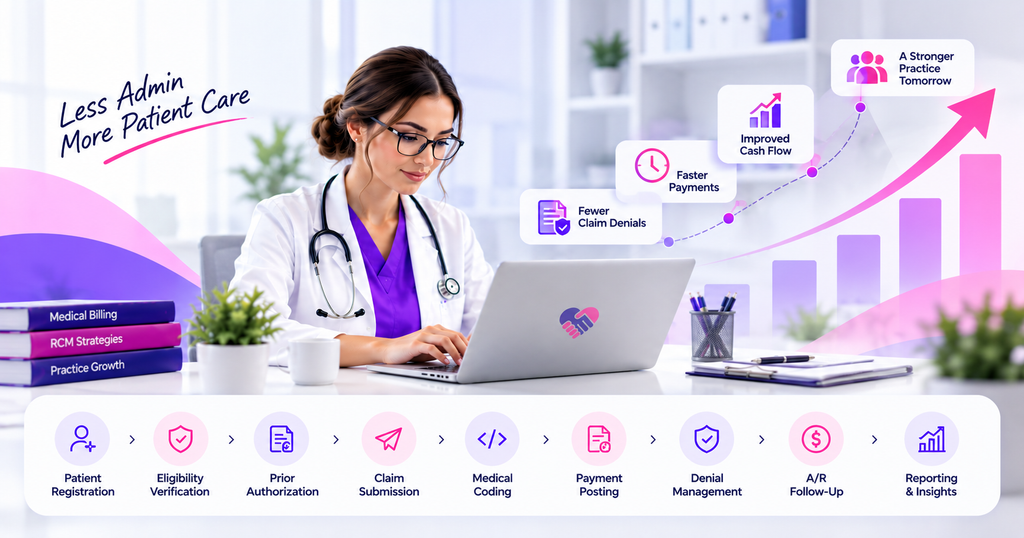
Eligibility → Authorization → Documentation → Coding → Claims → Payments → Denials → A/R → Reporting
For some U.S. healthcare practices, an experienced internal billing department remains the right choice. For others, outsourced medical billing services can reduce staffing pressure, improve operational consistency, strengthen follow-up, and make it easier to scale.