
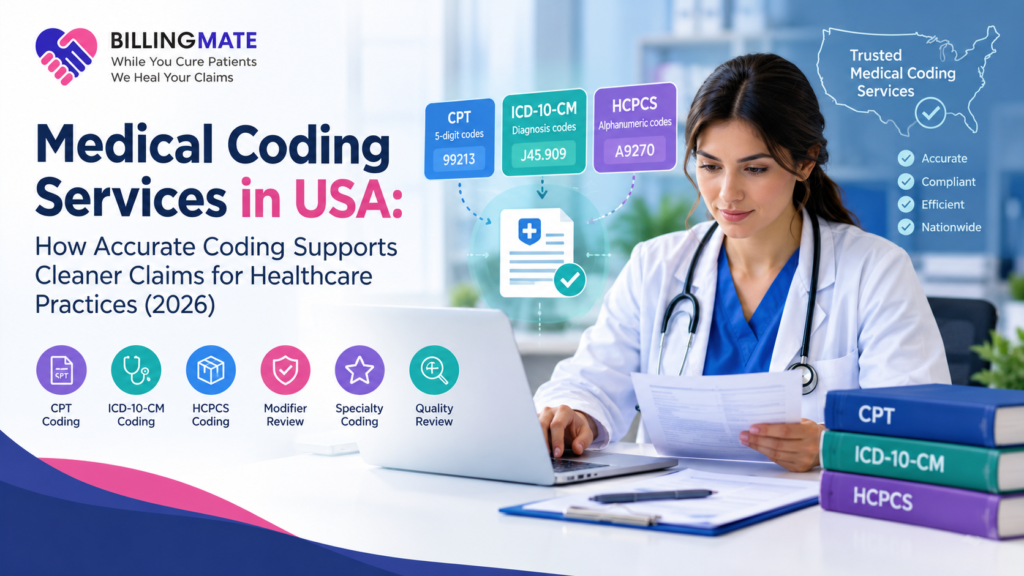
Accurate medical coding is one of the most important connections between clinical documentation and medical billing.
For U.S. healthcare practices, coding is not simply entering numbers into a claim. The codes selected must accurately reflect the services and conditions documented in the medical record while fitting applicable payer and coding requirements.
Incomplete or inconsistent coding can contribute to claim rejections, denials, payment delays, and unnecessary billing rework.
That is why healthcare organizations looking for medical coding services in USA should evaluate more than basic code entry. They need a structured coding process that considers documentation, specialty requirements, modifiers, payer rules, and downstream claim performance.
BillingMate’s medical coding services support CPT, ICD-10-CM, HCPCS, modifier review, specialty coding, and coding quality workflows for healthcare practices.

What Are Medical Coding Services?
Medical coding services help translate documented patient care into codes that can be used within the medical billing process.
BillingMate’s coding workflow covers six primary areas:
- CPT coding
- ICD-10-CM coding
- HCPCS coding
- Modifier review
- Specialty coding
- Coding quality review
The process begins with the documentation already present in the patient’s medical record. BillingMate specifically states that coding decisions should reflect documented care rather than assumptions based on the encounter type.
For U.S. healthcare organizations, that makes medical coding a critical bridge between clinical documentation and claim preparation.
Why Accurate Medical Coding Matters
Coding affects what happens after a patient encounter.
A typical workflow may look like:
Clinical Documentation → Medical Coding → Claim Preparation → Claim Scrubbing → Submission → Payer Review → Payment or Denial
If coding information is incomplete or inconsistent, the issue can move downstream into the billing process.
BillingMate identifies coding-related inconsistencies as a potential contributor to:
- Claim rejections
- Denials
- Payment delays
- Additional billing rework
A stronger coding process therefore helps prepare cleaner claims before they reach the payer.
Quick Answer: What Should Medical Coding Services Include?
For practices comparing medical coding services in the USA, a structured service should address more than one coding system.
BillingMate’s current service model includes:
| Coding Area | BillingMate’s Approach |
| CPT Coding | Procedure and professional-service coding based on clinical documentation |
| ICD-10-CM Coding | Diagnosis coding based on documented conditions, symptoms and findings |
| HCPCS Coding | Coding support for applicable supplies, drugs, services and procedures |
| Modifier Review | Modifier use reviewed against documentation and procedure relationships |
| Specialty Coding | Workflows adapted to specialty-specific services and documentation |
| Quality Review | Review of recurring inconsistencies and documentation gaps |
1. CPT Coding
CPT coding is an important part of BillingMate’s medical coding service.
BillingMate uses available clinical documentation and applicable coding guidance when assigning procedure and professional-service codes.
For a healthcare practice, the critical principle is:
The code should reflect the service documented in the medical record.
The coding team should not make unsupported assumptions simply because a particular code is commonly associated with a type of visit.
This documentation-first approach helps improve coding consistency before claims are submitted.
2. ICD-10-CM Coding
BillingMate also supports ICD-10-CM coding.
The objective is to represent documented diagnoses, symptoms, conditions, and clinical findings at the level of specificity supported by the record.
This is particularly important because medical coding is closely connected with clinical documentation.
If documentation does not contain enough information to support accurate code selection, the coding workflow should identify that gap rather than simply guessing.
3. HCPCS Coding
For healthcare services requiring HCPCS reporting, BillingMate provides HCPCS coding support for applicable:
- Supplies
- Drugs
- Services
- Procedures
For practices evaluating a medical coding company in USA, this broader coding coverage matters because not every claim involves only one code set.
A coding workflow should be capable of handling the coding requirements relevant to the practice’s actual services.
4. Modifier Review
Modifiers can affect how a payer interprets the relationship between services.
BillingMate includes modifier review within its coding service and evaluates modifier use based on:
Inconsistent modifier usage can create avoidable billing questions later.
That is why modifier review should be part of the coding workflow before the claim is submitted.
5. Specialty Medical Coding Services
Medical coding is not identical across every specialty.
BillingMate notes that specialties can have different challenges involving:
- Modifier rules
- Global periods
- Procedure bundling
- Diagnostic services
- Documentation requirements
Its coding workflows can be adapted for specialties including cardiology, dermatology, orthopedics, radiology, ophthalmology, family medicine, behavioral health, urology, gastroenterology, neurology, pain management, general surgery, anesthesiology, pathology, oncology and podiatry.
This makes specialty medical coding services particularly relevant for practices where generic coding workflows may not reflect the procedures and documentation patterns used every day.
6. Coding Quality Reviews
Medical coding quality should not only be evaluated when a payer denies a claim.
BillingMate’s coding service includes targeted quality reviews designed to identify:
- Coding inconsistencies
- Documentation gaps
- Recurring error patterns
- Modifier issues
- Missed coding opportunities
- Payer-specific requirements
The purpose is to identify patterns before they create larger revenue-cycle problems.
A coding review should answer:
What keeps going wrong?
Why is it happening?
Does documentation need improvement?
Does the coding workflow need to become more consistent?
Medical Coding Should Start With Documentation
One of the clearest points on BillingMate’s medical coding service page is that accurate coding starts with clear documentation.
This means coders and providers cannot operate completely independently.
Documentation needs to provide enough clinical detail to support the coding decision.
A practical workflow is:
Provider Documentation → Coding Review → Claim Preparation
When documentation gaps are identified, that feedback can also help providers strengthen future records.
This creates a continuous improvement cycle rather than repeatedly correcting the same issues after claims have been submitted.
How Medical Coding Supports Cleaner Claims
Medical coding does not operate in isolation.
BillingMate connects coding with its wider medical billing services, which include:
- Eligibility and benefits verification
- Charge entry and claim preparation
- Claim scrubbing and submission
- Payment posting and reconciliation
- Denial management and appeals
- A/R follow-up
That connected workflow matters.
A coding issue identified during denial management can provide information that helps improve future claim preparation.
For example:
Coding issue identified → Claim reviewed → Root cause understood → Coding workflow updated
Instead of treating coding and billing as two separate departments, BillingMate connects downstream claim feedback with upstream coding processes.
Medical Coding and Claim Scrubbing
After coding, a claim still needs to be reviewed before submission.
BillingMate’s medical billing workflow includes claim scrubbing for common issues involving:
- Demographics
- Coding
- Modifiers
- Payer rules
before electronic submission.
This creates another quality-control point.
A strong U.S. medical billing workflow therefore looks more like:
Documentation → Coding → Claim Preparation → Claim Scrubbing → Submission
rather than simply:
Coding → Submit
Each stage provides an opportunity to identify avoidable problems earlier.
Medical Coding and Denial Management
Denials can provide valuable information about coding quality.
BillingMate’s medical billing process reviews denied claims by root cause and, where appropriate, corrects, resubmits, or appeals them according to payer requirements.
Coding-related denial information can then help identify:
- Repeated code-selection issues
- Modifier inconsistencies
- Documentation gaps
- Payer-specific coding problems
BillingMate specifically describes coding questions as being connected with denial and claim feedback so recurring issues become easier to identify.
This creates a stronger feedback loop:
Code → Submit → Review Payer Feedback → Improve Coding
Why Specialty Awareness Matters
A cardiology practice and a dermatology practice do not necessarily have the same coding workflow.
BillingMate’s broader medical billing service also recognizes that specialties can differ in:
For healthcare organizations evaluating medical coding services for healthcare practices, specialty familiarity can therefore be an important consideration.
The coding process should fit the services the practice actually provides rather than forcing every specialty into a generic workflow.
When Should a Practice Review Its Coding Workflow?
A coding review may be appropriate when a practice begins experiencing:
- Coding-related denials
- Inconsistent modifier usage
- Documentation gaps
- Repeated claim corrections
- Coding inconsistencies between providers
- Specialty-specific coding challenges
BillingMate specifically identifies coding-related denials, inconsistent modifier use, and documentation gaps as situations where a coding workflow review may help identify practical improvements.
Practices should not necessarily wait until these problems become large.
Regular quality reviews can help reveal patterns earlier.
Medical Coding Services vs. Medical Billing Services
Medical coding and medical billing are closely connected, but they are not identical.
Medical coding focuses on translating documented care into appropriate codes.
Medical billing manages the larger claim and reimbursement workflow.
BillingMate’s full-cycle billing service includes:
Eligibility → Charge Preparation → Claim Scrubbing → Submission → Payment Posting → Denial Management → A/R Follow-Up
while its coding service supports CPT, ICD-10-CM, HCPCS, modifier and specialty coding.
Together, these services create a more connected revenue-cycle workflow.
What Should U.S. Practices Look for in a Medical Coding Company?
When comparing medical coding services in USA, practices should evaluate whether the coding provider offers:
Documentation-Based Coding
Codes should reflect information actually documented in the medical record.
Multiple Coding Functions
Support should cover the coding systems relevant to the practice.
Modifier Review
Modifiers should be evaluated within the context of documentation and procedures.
Specialty-Specific Workflows
Coding should account for specialty-specific services and documentation patterns.
Quality Review
The team should identify recurring inconsistencies rather than simply process encounters.
Revenue-Cycle Integration
Coding information should connect with claims and denial feedback.
These principles closely match BillingMate’s current medical coding workflow.
How BillingMate Supports Medical Coding Services Across the USA
BillingMate provides medical coding services for healthcare practices alongside full-cycle medical billing and revenue cycle management.
Its website lists support for:
- CPT coding
- ICD-10-CM coding
- HCPCS coding
- Modifier review
- Specialty coding
- Coding quality review
BillingMate also states that it supports providers nationwide and works across all 50 states as part of its broader revenue-cycle offering. The key advantage of its coding model is that coding is connected with the larger billing process.
Issues identified during claims, denials, or billing review can be used to improve coding and claim preparation upstream.
Frequently Asked Questions
What are medical coding services?
Medical coding services translate documented healthcare services, diagnoses, and related clinical information into codes used within the medical billing workflow.
What coding services does BillingMate provide?
BillingMate provides CPT coding, ICD-10-CM coding, HCPCS coding, modifier review, specialty coding, and coding quality review
Does BillingMate provide medical coding services in the USA?
Yes. BillingMate states that its broader billing and RCM services support healthcare providers nationwide and across all 50 states.
Can medical coding errors cause claim problems?
BillingMate states that incomplete or inconsistent coding can contribute to claim rejections, denials, delays, and billing rework.
Does BillingMate support specialty medical coding?
Yes. BillingMate lists coding support across specialties including cardiology, dermatology, orthopedics, radiology, ophthalmology, behavioral health, urology, neurology and several others.
Does medical coding work separately from medical billing?
The functions are different but closely connected. BillingMate integrates coding with claim preparation, submission, denials, payments, and reporting as part of the broader revenue cycle.
Does BillingMate review modifiers?
Yes. Modifier review is included in BillingMate’s medical coding service and is based on documentation, procedure relationships, and payer requirements.
Final Thoughts
For U.S. healthcare practices, accurate medical coding is an important part of building cleaner, more consistent billing workflows.
The process should not be treated as a simple code entry.
A stronger workflow connects:
Documentation → CPT / ICD-10-CM / HCPCS → Modifier Review → Quality Review → Claim Preparation → Claim Scrubbing → Payer Feedback
That connection allows healthcare organizations to identify recurring coding and documentation problems before they continue creating unnecessary billing work.
For practices looking for medical coding services in USA, BillingMate provides structured coding support covering CPT, ICD-10-CM, HCPCS, modifiers, specialty workflows, and quality reviews while connecting coding with its wider medical billing process.