
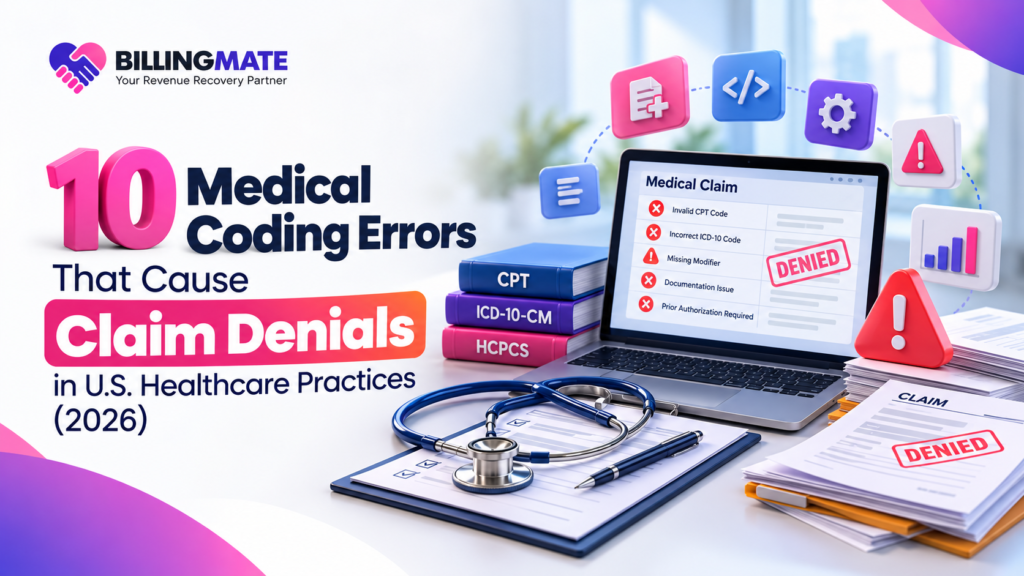
Medical coding errors can turn an otherwise valid patient encounter into a rejected claim, delayed payment, or avoidable denial.
For U.S. healthcare practices, coding accuracy is not simply a back-office responsibility. It connects clinical documentation with claim preparation, payer requirements, reimbursement, denial management, and accounts receivable.
A strong medical coding workflow should therefore do more than assign CPT, ICD-10-CM, and HCPCS codes. It should also review modifiers, documentation, specialty requirements, payer edits, and recurring denial patterns before the same mistakes continue affecting future claims.
BillingMate’s medical coding services support healthcare practices with CPT, ICD-10-CM, HCPCS, modifier review, specialty coding, and coding quality workflows connected with the broader revenue cycle.
Quick Answer: What Medical Coding Errors Commonly Cause Claim Denials?
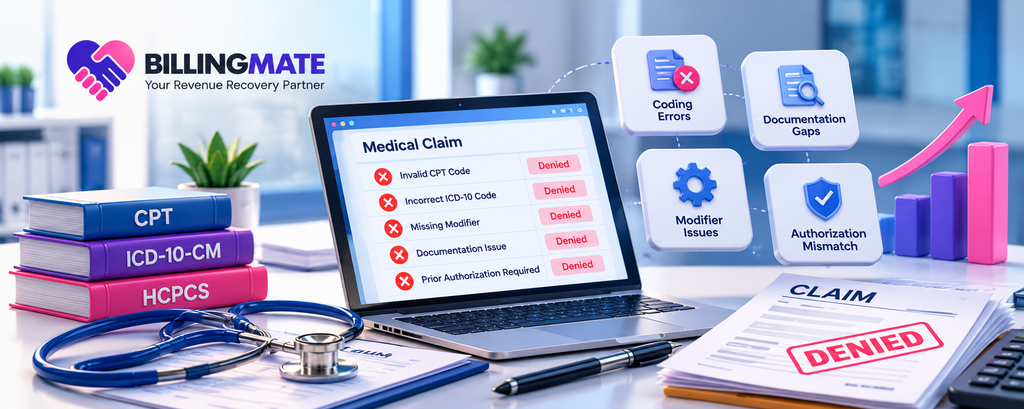
Common medical coding errors include incorrect CPT selection, inaccurate ICD-10-CM coding, missing or incorrect modifiers, outdated codes, diagnosis-to-procedure inconsistencies, insufficient documentation, incorrect HCPCS coding, authorization mismatches, specialty-specific coding mistakes, and failure to learn from recurring coding denials.
The important point is that many coding denials are not random.
When the same type of denial keeps appearing, it may indicate a weakness in the coding or documentation workflow rather than a problem with one individual claim.
BillingMate discusses this root-cause approach in its guide to preventable medical billing denial causes.
Why Medical Coding Accuracy Matters in the Revenue Cycle
Medical coding sits between clinical documentation and claim submission.
A simplified workflow looks like:
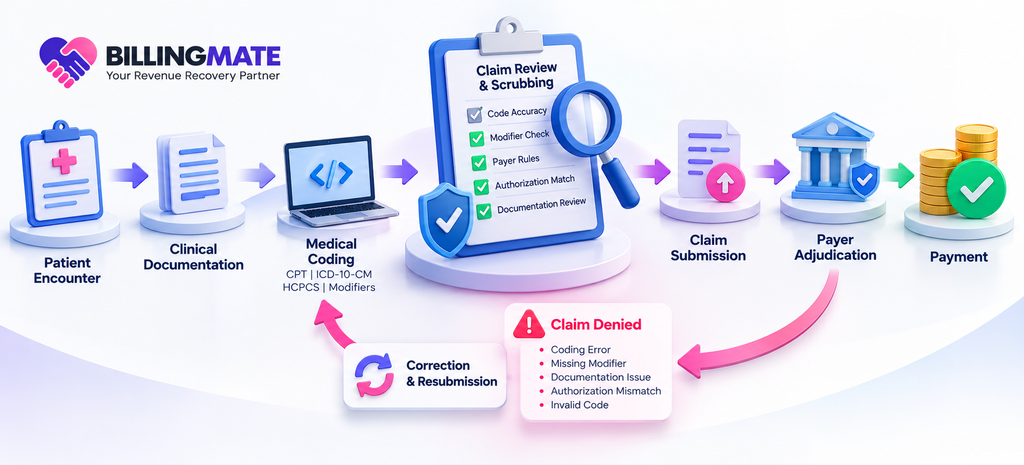
Patient Encounter → Documentation → Medical Coding → Claim Review → Claim Scrubbing → Submission → Payer Adjudication → Payment or Denial
An error during coding may not become visible immediately.
The practice may only discover the problem after the payer rejects or denies the claim.
At that point, staff may need to:
- Review documentation
- Identify the coding issue
- Correct the claim
- Resubmit it
- Monitor claim status
- Appeal when appropriate
That creates unnecessary administrative work.
A more efficient approach is to identify preventable coding problems before the claim reaches the payer.
For a wider look at how coding fits into the revenue cycle, see BillingMate’s guide to the medical billing process from patient registration to final payment.
1. Incorrect CPT Code Selection
One of the most important medical coding errors is selecting a CPT code that does not accurately reflect the documented professional service or procedure.
Problems can occur when the code:
- Does not match the service performed
- Does not reflect the documentation
- Is selected based on assumptions
- Does not fit applicable payer requirements
The coding process should begin with the medical record—not with the reimbursement amount associated with a code.
Better Approach
Review the documented service carefully and select the CPT code supported by the available clinical documentation.
When documentation is unclear, the workflow should include an escalation process rather than forcing the coder to guess.
Key takeaway: CPT coding should accurately reflect the service documented in the medical record.
2. Incorrect ICD-10-CM Diagnosis Coding
Diagnosis coding helps communicate the patient’s condition, symptoms, or reason for care.
If the ICD-10-CM code does not accurately reflect the documentation, the relationship between the diagnosis and billed service may become unclear.
Common Problems
A practice may encounter issues when:
- The diagnosis lacks supported specificity
- The wrong diagnosis is selected
- The diagnosis does not align with the documented encounter
- The diagnosis and procedure combination raises payer questions
Better Approach
Diagnosis coding should reflect what the provider actually documented.
The coding team should not add clinical detail that is not supported by the medical record.
Key takeaway: Accurate ICD-10-CM coding begins with accurate clinical documentation.
3. Missing Modifiers
Modifiers provide additional information about how a service or procedure was performed.
When a required modifier is missing, the payer may not receive enough information to correctly interpret the claim.
Modifier review is one of the areas covered within BillingMate’s medical coding services.
Better Approach
Before claim submission, review whether the documented circumstances and applicable billing requirements support a modifier.
Modifier review should be part of the coding-quality process rather than something addressed only after a denial occurs.
Key takeaway: Missing modifier problems can often be identified during pre-submission review.
4. Incorrect Modifier Usage
Adding a modifier does not automatically make a claim more accurate.
The modifier also needs to be appropriate for the documented service and procedure relationship.
Incorrect modifier usage can create:
- Claim edits
- Payer questions
- Denials
- Payment discrepancies
- Additional billing rework
Better Approach
Evaluate modifiers against:
- The medical record
- Service performed
- Procedure relationships
- Specialty requirements
- Applicable payer requirements
Practices should also monitor recurring modifier-related denials by provider, payer, procedure, and specialty.
Key takeaway: Modifier accuracy requires context, not simply code selection.
5. Using Outdated Medical Codes
Medical coding workflows should remain current.
Codes may be introduced, revised, or removed, while payer processing requirements can also change.
A practice that continues using outdated coding information may create avoidable claim problems.
Better Approach
Maintain a structured process for:
- Reviewing coding updates
- Updating internal coding references
- Training coding staff
- Reviewing affected specialties
- Monitoring denial patterns after coding changes
Waiting for denials to reveal an outdated coding workflow is inefficient.
Key takeaway: Coding maintenance should be proactive rather than denial-driven.
6. Diagnosis and Procedure Inconsistencies
A claim should make sense as a complete clinical and billing record.
Even when an individual diagnosis code and procedure code appear valid separately, the payer may question the claim if the relationship between them is inconsistent with the documentation.
Better Approach
Before submission, review whether:
- The diagnosis reflects the documented condition
- The procedure reflects the documented service
- The overall claim is supported by the medical record
This is where coding quality review and claim scrubbing can work together.
BillingMate’s medical billing services connect coding with claim preparation, claim scrubbing, submission, payment posting, denial management, and A/R follow-up.
Key takeaway: Coding accuracy should be evaluated at the claim level, not only code by code.
7. Documentation Does Not Support the Billed Service
Even technically correct codes can create problems when the documentation does not support the service being billed.
Useful documentation should clearly support relevant aspects of the encounter, including:
- Reason for the patient visit
- Clinical findings
- Assessment or diagnosis
- Services performed
- Treatment plan
- Date of service
- Appropriate provider documentation
The coding team should not be expected to create clinical support after the encounter.
Better Approach
Track recurring documentation-related problems by provider, procedure, specialty, and payer.
If the same documentation issue repeatedly contributes to denials, the solution should include provider feedback and workflow improvement.
Key takeaway: A claim cannot be stronger than the documentation supporting it.
8. Incorrect HCPCS Coding
Some healthcare claims require HCPCS coding for applicable services, supplies, drugs, equipment, or other billable items.
An incorrect HCPCS code can create downstream problems when the billed item or service does not align with the documentation or payer requirements.
BillingMate’s coding workflow includes CPT, ICD-10-CM, HCPCS, modifier, specialty, and coding-quality support through its medical coding service.
Better Approach
HCPCS coding should be reviewed within the context of:
- The documented service
- Applicable quantities or units
- Payer requirements
- Related procedure coding
- Supporting information
Key takeaway: HCPCS coding should be integrated into the complete claim-review process rather than treated as isolated data entry.
9. Coding Does Not Match Prior Authorization
A claim may be coded accurately based on the service provided and still encounter problems if the billed procedure does not match what the payer previously authorized.
This is particularly important when:
- A procedure changes
- Multiple procedures are performed
- Approved units are limited
- Authorization expires
- Provider information changes
- Facility information changes
- The billed procedure differs from the approved service
BillingMate explains these issues in more detail in its guide to prior authorization denials in U.S. healthcare practices.
Better Approach
Before claim submission, connect authorization information with coding and billing.
The billing team should confirm:
- Whether authorization was required
- What service was approved
- Approved units
- Effective dates
- Provider information
- Whether the billed service still matches the authorization
Key takeaway: Prior authorization and medical coding should not operate as completely separate workflows.
10. Ignoring Recurring Coding Denial Patterns
One of the biggest medical coding mistakes is not the original coding error.
It is allowing the same error to happen repeatedly.
A practice may correct and resubmit one denied claim successfully—but if the root cause is never identified, future claims may encounter the same problem.
Better Approach
Track coding denials by:
- Payer
- Provider
- Procedure
- Modifier
- Specialty
- Denial reason
- Root cause
Then ask:
Why did this happen?
Has it happened before?
Was the problem documentation, coding, authorization, claim preparation, or payer interpretation?
What process needs to change?
This transforms denial management from reactive correction into process improvement.
BillingMate’s guide to medical billing denial management explains why identifying recurring denial causes is more valuable than simply correcting claims one at a time.
Key takeaway: A repeated coding denial usually deserves a workflow review, not just another corrected claim.
How Medical Coding Errors Affect Medical Billing
Medical coding and medical billing are different functions, but they are closely connected.
A broader medical billing workflow can include:
Eligibility Verification → Coding → Claim Preparation → Claim Scrubbing → Submission → Payment Posting → Denial Management → A/R Follow-Up
When a coding error reaches the payer, it may affect several downstream teams.
A single error can potentially require:
Coder Review → Claim Correction → Resubmission → Payer Follow-Up → Payment Monitoring
That is why accurate coding should be viewed as part of revenue cycle management rather than as a standalone administrative function.
Healthcare practices evaluating outsourced RCM can also review BillingMate’s guide on how to choose medical billing services in the USA.
How Claim Scrubbing Helps Identify Coding Problems
Claim scrubbing provides another quality-control checkpoint before submission.
Pre-submission review may help identify problems involving:
- Coding
- Modifiers
- Payer information
- Authorization
- Provider information
- Required claim fields
This does not guarantee that every claim will be paid.
Payers may still deny claims for coverage, medical necessity, contractual, authorization, or administrative reasons.
The objective is to reduce preventable problems before they enter payer adjudication.
Why Specialty-Specific Medical Coding Matters
Medical coding requirements can differ substantially between specialties.
Modifier rules, bundling logic, procedures, documentation requirements, and payer expectations can change according to the type of healthcare practice.
Specialty-aware coding may be particularly useful for areas such as:
- Cardiology
- Orthopedics
- Radiology
- Dermatology
- Neurology
- Behavioral health
- Gastroenterology
- Urology
- Ophthalmology
- Pain management
- General surgery
A coding team should understand the procedures, documentation patterns, and billing challenges associated with the specialty it supports.
How U.S. Healthcare Practices Can Reduce Coding-Related Denials
A practical denial-prevention workflow should connect medical coding with both upstream and downstream revenue-cycle processes.
A stronger process looks like:
Clinical Documentation → Coding Review → Modifier Review → Authorization Check → Claim Scrubbing → Submission → Denial Tracking → Root-Cause Feedback
This creates a continuous learning loop.
For example:
Coding Denial → Identify Root Cause → Correct Claim → Update Coding Workflow → Monitor Future Claims
This approach helps prevent healthcare practices from repeatedly correcting the same issue.
Medical Coding Errors and Accounts Receivable
Coding problems can also contribute to aging A/R.
When a denied or rejected claim remains unresolved, the balance continues moving through A/R aging buckets.
A strong revenue-cycle workflow should therefore connect coding corrections with follow-up on unpaid claims.
Practices experiencing growing aging balances can also review BillingMate’s guide on how to reduce A/R days in medical billing.
Coding accuracy alone will not solve every A/R issue, but reducing avoidable coding rework can help remove one potential cause of payment delays.
When Should a Practice Review Its Medical Coding Workflow?
Healthcare practices should consider reviewing their coding workflow when they experience recurring:
- Coding-related denials
- Modifier problems
- Documentation gaps
- Claim corrections
- Payer-specific coding issues
- Specialty coding inconsistencies
- Payment delays
- Excessive billing rework
The objective should not be to promise that every denial can be eliminated.
Some payer decisions, eligibility problems, coverage restrictions, and authorization requirements are outside the control of the coding team.
The more practical objective is to identify preventable coding patterns, correct the underlying process, and prepare cleaner claims before submission.
How BillingMate Supports Medical Coding and Denial Management
BillingMate provides medical coding services for U.S. healthcare practices as part of a broader revenue-cycle workflow.
Its service structure covers areas such as:
- CPT coding
- ICD-10-CM coding
- HCPCS coding
- Modifier review
- Specialty coding
- Coding quality review
- Claim scrubbing
- Denial management
- Corrected claims
- A/R follow-up
- Payment posting
- Billing audits
Connecting these functions allows information from denied claims to be used to improve future coding and claim preparation.
Instead of correcting the same problem repeatedly, practices can use denial data to identify where the workflow needs to improve.
Frequently Asked Questions
What are the most common medical coding errors?
Common coding problems include incorrect CPT selection, inaccurate ICD-10-CM coding, missing or incorrect modifiers, outdated codes, diagnosis-to-procedure inconsistencies, HCPCS errors, and documentation that does not support the billed service.
Can medical coding errors cause claim denials?
Yes. Coding inconsistencies can contribute to claim rejections, denials, payment delays, and billing rework.
However, medical coding is only one possible source of denials. Eligibility, prior authorization, documentation, credentialing, payer requirements, and other revenue-cycle issues can also create problems.
Can accurate medical coding prevent every claim denial?
No.
Accurate coding can help reduce preventable coding-related problems, but it cannot eliminate denials caused by coverage limitations, authorization issues, payer policies, eligibility problems, or other factors outside the coding process.
Why do modifiers cause medical billing denials?
Modifiers may create problems when they are missing, unsupported, inconsistent with documentation, or inappropriate for the procedure or payer requirement.
How can practices reduce coding denials?
Healthcare practices can improve documentation, maintain current coding workflows, review modifiers, connect coding with authorization, scrub claims before submission, and analyze recurring denial root causes.
Should medical coding and denial management work together?
Yes.
Coding-related denial information can be fed back into coding and documentation workflows so recurring issues become easier to identify and correct.
Does BillingMate provide medical coding services in the USA?
BillingMate provides medical coding and broader revenue-cycle support for U.S. healthcare practices, including CPT, ICD-10-CM, HCPCS, modifier review, specialty coding, claim scrubbing, denial management, and A/R follow-up.
Final Thoughts
Medical coding errors should not be treated only as individual claim problems.
When incorrect CPT coding, ICD-10-CM inconsistencies, modifier issues, documentation gaps, HCPCS problems, or authorization mismatches continue appearing, the practice should investigate the workflow creating those errors.
The stronger approach is:
Document Accurately → Code Accurately → Review the Claim → Scrub Before Submission → Track Denials → Fix the Root Cause
For U.S. healthcare practices, this creates a more connected medical billing and coding process while reducing avoidable administrative rework.
BillingMate’s medical coding services connect coding with claim preparation, claim scrubbing, denial management, payment workflows, and A/R follow-up so problems discovered downstream can help strengthen future claims.