


Claim denials are often treated as a back-office billing problem. In reality, many denials begin much earlier in the revenue cycle.
An incorrect insurance ID entered during registration, an eligibility check that was never completed, missing prior authorization, incomplete documentation, or a coding inconsistency can all affect whether a claim moves smoothly through adjudication.
For U.S. medical practices, effective medical billing denial management should not begin only after a payer refuses payment. It should begin before the claim is submitted.
A stronger denial-management strategy identifies where errors originate, resolves existing claims correctly, and uses denial data to improve the workflow that produced the problem in the first place.
What Is Medical Billing Denial Management?
Medical billing denial management is the process of identifying, analyzing, correcting, appealing when appropriate, and preventing denied claims.
A strong denial-management workflow should answer three questions:
What happened?
Identify whether the issue involves eligibility, authorization, patient demographics, coding, documentation, medical necessity, timely filing, claim submission, or payer-specific requirements.
Why did it happen?
The denial reason alone may not reveal the operational cause. A prior-authorization denial, for example, could result from missing approval, incorrect service information, expired authorization, or incomplete documentation.
How can the same problem be prevented?
This is where denial management becomes a revenue-cycle improvement function rather than simply a claim-correction process.
Every recurring denial should lead to a workflow review.
1. Incorrect Patient and Insurance Information
One of the earliest opportunities for a claim problem occurs during patient registration.
Small errors can create significant downstream work.
Common problems include:
- Incorrect member ID
- Misspelled patient name
- Wrong date of birth
- Outdated insurance information
- Incorrect subscriber details
- Wrong payer selection
- Missing coordination-of-benefits information
When these problems are discovered after claim submission, staff may need to investigate the rejection, update the patient record, correct the claim, resubmit it, and monitor it again.
That creates avoidable administrative work.
A better approach is to treat registration accuracy as part of the revenue cycle.
Before the encounter, practices should verify demographic information, confirm current insurance details, review subscriber information, and resolve obvious discrepancies before claim creation.
Key takeaway: Front-office data quality directly affects back-office billing efficiency.
2. Eligibility Verification Gaps
Having an insurance card does not necessarily confirm that coverage is active for the date of service.
Eligibility verification helps practices confirm coverage status and identify relevant benefit information before services are billed.
Medical practices should pay particular attention to:
- Active versus inactive coverage
- Effective dates
- Plan changes
- Primary and secondary insurance
- Service-specific coverage
- Coordination of benefits
- Patient financial responsibility
Eligibility information should also be checked close enough to the date of service that it remains useful.
A verification completed several months earlier may no longer reflect the patient’s current coverage.
A stronger workflow uses eligibility verification as a pre-service checkpoint rather than waiting for a payer response to reveal a coverage problem.
Key takeaway: The earlier coverage issues are identified, the fewer avoidable claim corrections are required later.
3. Missing or Incorrect Prior Authorization
Prior authorization remains one of the most operationally demanding areas of healthcare reimbursement.
Depending on the payer and service, staff may need to determine whether authorization is required, collect clinical information, submit the request, monitor the payer response, provide additional documentation, and ensure the authorization matches the service ultimately performed.
Common authorization problems include:
- Authorization not obtained
- Incorrect procedure information
- Wrong provider or location
- Expired authorization
- Approved units exceeded
- Missing supporting documentation
- Service performed does not match the approved service
A strong authorization workflow connects scheduling, clinical documentation, payer requirements, and billing.
Authorization status should not exist in isolation within one department.
Key takeaway: An authorization problem discovered before service delivery is generally easier to resolve than one discovered after a claim is denied.
4. Medical Coding and Modifier Errors
Medical coding converts documented clinical services into information payers can process.
That makes coding accuracy critical to the revenue cycle.
Problems can arise from:
- Incorrect CPT selection
- Incorrect ICD-10-CM diagnosis coding
- Missing modifiers
- Incorrect modifier usage
- Diagnosis and procedure inconsistencies
- Outdated codes
- Documentation that does not support the billed service
Coding should not be treated as selecting the closest-looking code from a list.
The code must reflect the documented service and applicable coding and payer requirements.
A strong coding workflow should also include a clear escalation process when documentation does not provide enough information to code confidently.
Practices should periodically review recurring code-related denials, modifier patterns, provider-specific error trends, specialty requirements, and documentation-to-code consistency.
Key takeaway: Repeated coding denials usually indicate a workflow problem rather than a series of unrelated mistakes.
5. Incomplete Clinical Documentation
Accurate coding depends on accurate documentation.
Even when a claim appears technically complete, a payer may review whether the medical record supports the billed service.
Useful documentation should clearly support:
- Why the patient was seen
- Relevant clinical findings
- Assessment or diagnosis
- Services performed
- Medical decision-making where applicable
- Treatment plan
- Date of service
- Provider identification and authentication
Billing staff should not be expected to create support for a service after the encounter.
Instead, recurring documentation problems should become part of provider education and workflow improvement.
Practices can track documentation-related denials by provider, procedure, location, payer, and denial reason.
Patterns are far more useful than isolated cases.
Key takeaway: A claim can only be as defensible as the clinical record supporting it.
6. Medical Necessity and Payer-Specific Requirements
Not every denial comes from an administrative mistake.
Some claims may be denied because coverage, documentation, frequency, medical-necessity, or other payer requirements were not met.
That means practices should avoid treating every denial the same way.
A denial may require:
- Claim correction
- Additional documentation
- Coding review
- Authorization review
- Medical-necessity review
- Appeal
- No further action when the denial is valid
A structured denial process should categorize claims so management can identify patterns.
Useful questions include:
- Which payer produces the most denials?
- Which denial reason appears most frequently?
- Which services are affected repeatedly?
- Which providers or locations show recurring patterns?
- Which denials are preventable?
- Which denials require appeals?
Key takeaway: A denial report becomes valuable when it explains why reimbursement is being delayed, not simply how many claims were denied.
7. Timely Filing and Follow-Up Failures
A claim can be accurate and still become difficult or impossible to recover if filing or appeal deadlines are missed.
Payers establish different filing requirements, contractual timelines, and appeal periods.
A strong A/R workflow should identify:
- Claims that were not submitted successfully
- Rejected claims
- Claims pending unusually long
- Requests for additional information
- Corrected claims
- Appeal deadlines
- Claims approaching timely-filing limits
One major risk occurs when a rejected claim is mistaken for a claim that is simply processing.
A rejected claim may require correction before it ever reaches normal adjudication.
Every unresolved claim should have:
Status → Owner → Next Action → Deadline
Key takeaway: An unresolved claim without a defined next action can quickly become an aging A/R problem.
How U.S. Medical Practices Can Reduce Preventable Claim Denials
The goal should not simply be to work denials faster.
The stronger objective is to produce fewer preventable denials in the first place.
That requires connecting denial data back to earlier revenue-cycle processes.
Eligibility-related denials should trigger a review of registration and verification workflows.
Authorization denials should be reviewed with scheduling and prior-authorization teams.
Coding denials should be connected to coding and documentation review.
Timely-filing issues should lead to claim submission and A/R workflow analysis.
When the same denial reason continues appearing month after month, correcting individual claims is not enough.
The underlying process needs attention.
Move From Denial Correction to Denial Prevention
Consider two medical practices.
Practice A receives a denial, corrects it, resubmits the claim, and moves to the next account.
Practice B corrects the claim but also records:
- Denial category
- Root cause
- Payer
- Provider
- Procedure
- Department responsible
- Corrective action
At the end of the month, Practice B can identify patterns.
The practice may discover that one payer is repeatedly denying a particular modifier, one specialty has frequent authorization problems, one front-desk workflow is creating demographic errors, or one procedure frequently lacks sufficient supporting documentation.
That information can help prevent future denials.
This is the operational difference between denial processing and denial management.
How Denial Management Fits Into Revenue Cycle Management
Denial management should not operate in isolation.
The medical billing revenue cycle is interconnected:
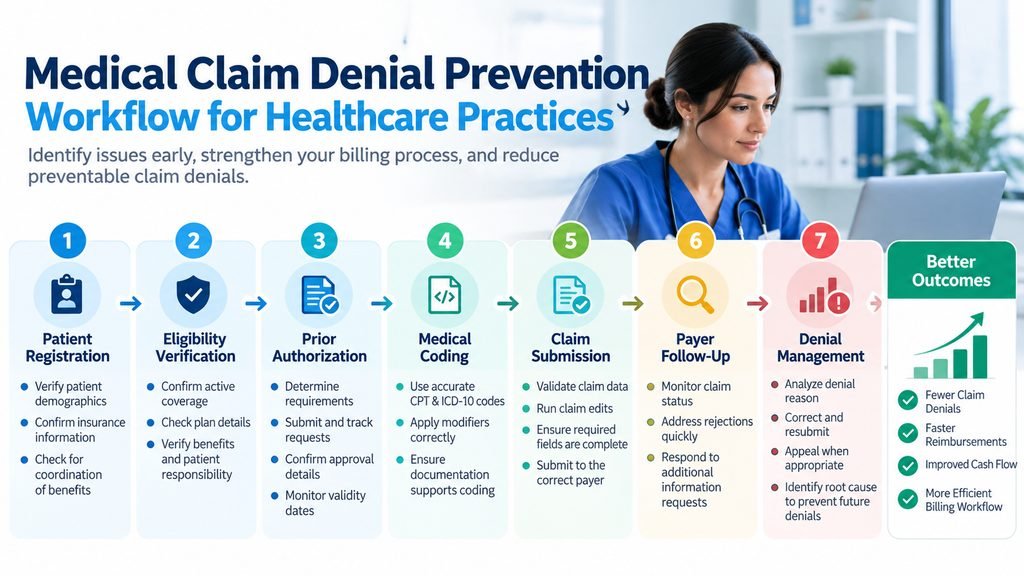
Patient Registration → Eligibility Verification → Prior Authorization → Clinical Documentation → Medical Coding → Claim Preparation → Claim Submission → Payment Posting → Denial Management → A/R Follow-Up
A failure at one stage frequently appears as a denial at another.
That is why denial findings should be shared with upstream teams.
A coding-related denial should influence coding review.
An eligibility denial should influence verification procedures.
An authorization denial should influence scheduling and authorization workflows.
This feedback loop is a critical part of effective revenue cycle management.
When Should a Medical Practice Review Its Denial Process?
A structured review may be appropriate when a practice experiences:
- Growing accounts receivable
- Repeated claim corrections
- Increasing authorization problems
- Frequent coding denials
- Recurring payer-specific issues
- High staff time spent on rework
- Unexplained reimbursement delays
- Large volumes of older unresolved claims
- Documentation-related payment issues
A medical billing audit can help determine whether these problems originate from isolated claims or broader workflow weaknesses.
The objective should not be to promise a completely denial-free environment.
Some payer decisions are legitimate and unavoidable.
The more realistic goal is to identify preventable denial patterns, correct them earlier, and reduce unnecessary administrative rework.
Medical Billing Denial Management Checklist for 2026
Before the Visit
- Confirm patient demographics
- Verify insurance coverage
- Check eligibility
- Determine authorization requirements
- Verify referral requirements when applicable
During Documentation
- Document the reason for the encounter
- Record relevant findings
- Support services performed
- Complete required signatures and authentication
- Ensure documentation supports coding
Before Claim Submission
- Validate patient information
- Review payer information
- Check coding and modifiers
- Confirm authorization details
- Run claim edits
- Verify required claim fields
After Claim Submission
- Monitor acknowledgments
- Separate rejected claims from adjudicated denials
- Review denial reasons
- Correct actionable issues
- Appeal when appropriate
- Track deadlines
- Document the root cause
Monthly
- Review top denial categories
- Compare denial patterns by payer
- Identify recurring provider issues
- Review authorization trends
- Review coding trends
- Review aging A/R
- Assign corrective actions
What Medical Practices Should Measure
A denial-management dashboard should provide more information than a single denial percentage.
Denials by Payer
This helps identify payer-specific trends.
Denials by Reason
This shows which operational problems are creating the most rework.
Denials by Service or Procedure
This can reveal coding, authorization, or coverage patterns.
Denials by Provider
This may identify documentation or specialty-specific issues.
Denials by Age
This helps prioritize claims approaching filing or appeal deadlines.
Preventable vs. Non-Preventable Denials
This distinction helps management focus resources where workflow improvements can make a meaningful difference.
Why Root-Cause Analysis Matters
One corrected claim produces one corrected claim.
One corrected workflow can improve many future claims.
Consider an eligibility-related denial.
The immediate response may be to update the insurance information and resubmit the claim.
Root-cause analysis goes further:
- Why was coverage not verified?
- Was eligibility checked too early?
- Was updated insurance information missed?
- Was there no defined verification process?
- Did staff receive an eligibility response but fail to act on it?
Those questions create operational value beyond the individual account.
That is why denial management should include both claim-level action and process-level improvement.
How BillingMate Supports Stronger Medical Billing Workflows
BillingMate supports healthcare practices across key areas of the revenue cycle, including:
- Medical billing
- Revenue cycle management
- Medical coding
- Denial management
- Accounts receivable follow-up
- Provider credentialing
- Eligibility verification
- Prior authorization
- Payment posting
- Medical billing audits
The objective is not simply to work individual claims.
A stronger billing process connects front-end accuracy, claim preparation, coding, payer follow-up, denial analysis, and A/R management so healthcare practices can identify where reimbursement problems originate.
For practices experiencing recurring denials, rising A/R, or repeated claim corrections, reviewing the entire workflow can provide more useful answers than examining isolated claims.
Final Takeaway
Medical billing denial management in 2026 should be proactive rather than reactive.
For U.S. healthcare practices, many preventable denials begin before the payer ever receives the claim.
Registration accuracy, eligibility verification, prior authorization, documentation, coding, claim preparation, and timely follow-up all influence the final reimbursement outcome.
The stronger approach is not simply:
Denial → Correction → Resubmission
It is:
Denial → Root Cause → Correction → Workflow Improvement → Prevention
When denial data is used this way, it becomes more than a list of unpaid claims.
It becomes a practical tool for strengthening the entire revenue cycle.
BillingMate provides medical billing, denial management, coding, A/R follow-up, and revenue cycle support for healthcare practices across the United States.
Pingback: How to Reduce A/R Days in Medical Billing: 9 Strategies for U.S. Healthcare Practices (2026) - Billing Mate