
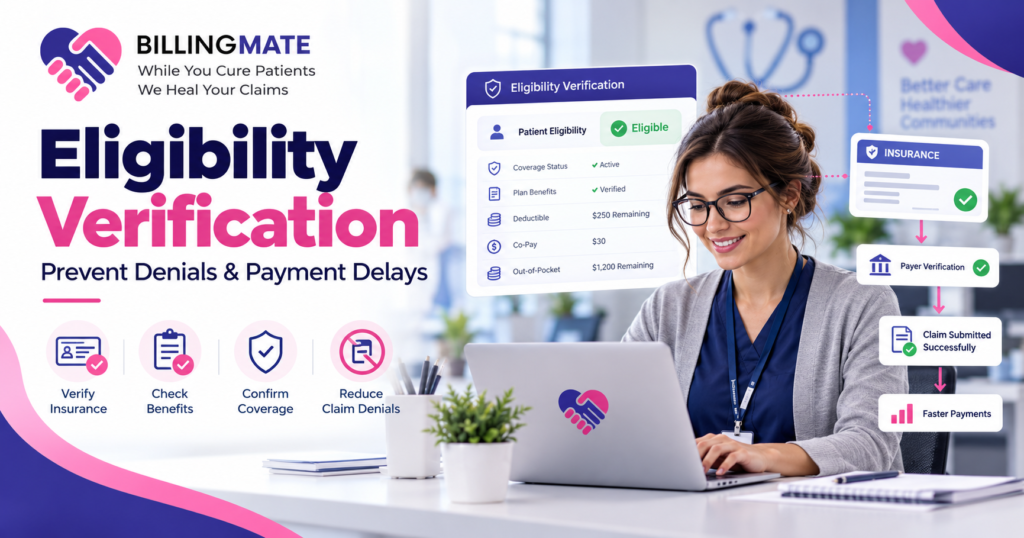
Eligibility errors can cause billing problems before a healthcare provider even sees the patient.
A patient may present an insurance card, but that does not automatically confirm that coverage is active, the provider is eligible under the plan, the requested service is covered, or prior authorization is not required.
For U.S. healthcare practices, eligibility verification in medical billing is one of the most important front-end revenue cycle processes because inaccurate insurance information can lead to rejected claims, denied claims, delayed reimbursement, unexpected patient balances, and unnecessary administrative work.
A strong verification process confirms insurance information before services are provided and gives the billing team the information needed to prepare cleaner claims.
BillingMate supports healthcare practices across the United States with eligibility verification, medical billing, medical coding, denial management, A/R follow-up, payment posting, provider credentialing, and broader revenue cycle management services.
What Is Eligibility Verification in Medical Billing?
Eligibility verification is the process of checking whether a patient’s health insurance coverage is active and determining relevant benefit information before healthcare services are provided.
The process may include confirming:
- Patient name
- Member ID
- Insurance payer
- Coverage status
- Effective date
- Termination date
- Plan type
- Copay
- Deductible
- Coinsurance
- Referral requirements
- Prior authorization requirements
- Coverage limitations
- Primary and secondary insurance
This process is sometimes called insurance eligibility verification, patient eligibility verification, or eligibility and benefits verification.
Although these terms are closely related, the objective is the same: confirm the patient’s current insurance information before the claim enters the billing cycle.
Quick Answer: Why Is Eligibility Verification Important?
Eligibility verification helps healthcare practices identify insurance problems before the date of service or before a claim is submitted.
It can help prevent:
- Inactive-coverage denials
- Wrong-payer submissions
- Invalid member information
- Missing authorization
- Incorrect patient responsibility
- Coordination-of-benefits issues
- Avoidable claim rework
- Payment delays
The strongest workflow is:
Verify First → Treat → Document → Code → Submit → Follow Up
rather than:
Treat → Bill → Discover Coverage Problem → Correct Claim
How Eligibility Verification Fits Into the Revenue Cycle
Eligibility verification is a front-end component of healthcare revenue cycle management.
However, its impact extends far beyond the front desk.
A typical revenue cycle looks like this:
Patient Registration → Eligibility Verification → Prior Authorization → Clinical Documentation → Medical Coding → Claim Submission → Payment Posting → Denial Management → A/R Follow-Up
If the insurance information collected at the beginning is incorrect, every stage after it may be affected.
For example, a patient may have changed insurance plans but provided an old card.
If the practice submits the claim to the outdated payer:
- The claim may be rejected or denied.
- Staff must investigate the patient’s current coverage.
- The claim must be corrected and resubmitted.
- Additional time enters the A/R cycle.
- Filing deadlines may become more important.
One front-end error can therefore create multiple back-end billing tasks.
What Should Be Verified Before a Patient Visit?
An effective medical billing eligibility verification process should confirm more than whether the insurance policy exists.
1. Active Insurance Coverage
The first question is simple:
Is the patient’s policy active on the expected date of service?
Coverage should be checked against the actual service date whenever possible.
Do not assume that insurance remains active because the patient used the same plan during a previous visit.
Employment, plan renewal, Medicaid eligibility, Medicare coverage, or commercial insurance enrollment may change.
2. Patient Demographics
Verify that the payer’s records align with information in the practice management system.
Check:
- Patient name
- Date of birth
- Member ID
- Group number where applicable
- Subscriber relationship
- Address where required
Even minor demographic mismatches can interfere with claim processing.
3. Plan Type
Knowing the patient’s payer is not always enough.
The plan may be:
- HMO
- PPO
- EPO
- POS
- Medicare
- Medicaid
- Medicare Advantage
- Commercial insurance
Plan type can influence referrals, network requirements, authorization, and patient financial responsibility.
4. Copay, Deductible, and Coinsurance
Eligibility and benefits verification should help determine what portion of the financial responsibility may fall to the patient.
Important information may include:
- Office visit copay
- Specialist copay
- Remaining deductible
- Coinsurance percentage
- Out-of-pocket status
Accurate information supports clearer financial communication before or at the time of service.
5. Referral Requirements
Certain plans may require a referral before a patient sees a specialist.
If a required referral is missing, the claim may experience reimbursement problems even if the patient’s insurance coverage is otherwise active.
6. Prior Authorization Requirements
Some services may require payer approval before they are delivered.
Examples can include certain:
- Imaging procedures
- Surgeries
- Specialty medications
- Infusion services
- Diagnostic procedures
- Therapies
- Durable medical equipment
Eligibility verification should therefore connect directly with the prior authorization workflow.
Real-Time Eligibility Verification in U.S. Medical Billing
Many healthcare organizations use electronic real-time eligibility verification to obtain insurance information quickly.
In U.S. healthcare transactions, eligibility checks commonly involve electronic inquiries and responses between the provider or clearinghouse and payer.
You may see these described as:
270 transaction: Eligibility and benefit inquiry
271 transaction: Eligibility and benefit response
These transactions can help practices retrieve coverage information electronically rather than relying entirely on manual payer calls.
However, automation does not remove the need for human review.
An electronic response may still require interpretation, particularly when:
- Benefits are complex
- Prior authorization rules are unclear
- Multiple insurance policies exist
- The patient’s plan recently changed
- Service-specific coverage needs confirmation
The best process combines technology with structured verification procedures.
Common Eligibility Verification Errors
Many avoidable claim problems begin with a small registration or verification error.
1. Using Outdated Insurance Information
Patients may forget to tell the practice that their health insurance has changed.
The insurance card stored in the EHR or practice management system may no longer be current.
Staff should confirm insurance information regularly rather than relying indefinitely on older records.
2. Failing to Verify Coverage for the Date of Service
A policy may be active today but not necessarily active on the planned treatment date.
Whenever practical, eligibility should reflect the expected date of service.
3. Assuming All Services Are Covered
Active coverage does not mean every service is covered.
A plan may have exclusions, limitations, authorization rules, or network requirements.
4. Missing Coordination of Benefits Information
Patients with more than one insurance plan may require correct identification of primary and secondary coverage.
Submitting the claim to the wrong payer first can delay reimbursement.
5. Ignoring Prior Authorization
Verification staff should identify whether an upcoming service requires authorization.
Finding out after the service has already been performed can create preventable revenue-cycle problems.
6. Incorrect Patient Information
Small errors involving:
- Member ID
- Date of birth
- Subscriber information
- Patient name
can result in rejected claims or additional payer follow-up.
How Eligibility Verification Prevents Claim Denials
Eligibility verification improves claim denial prevention by identifying billing risks before the claim is created.
Consider these examples.
Coverage Terminated
Without verification:
Service is provided → Claim submitted → Payer denies inactive coverage.
With verification:
Inactive coverage identified → Patient contacted → Updated insurance obtained → Correct payer billed.
Prior Authorization Required
Without verification:
Procedure completed → Claim submitted → Authorization denial.
With verification:
Authorization requirement identified → Approval obtained → Procedure performed → Claim submitted with correct information.
Wrong Primary Insurance
Without verification:
Claim submitted to secondary payer → Rejected or delayed.
With verification:
Coordination of benefits reviewed → Primary payer identified → Correct billing sequence followed.
This is why eligibility verification should be considered a denial-prevention function rather than a basic registration task.
1. Verify Insurance Before Every Important Encounter
Practices should establish policies for when eligibility must be verified.
Verification may be especially important for:
- New patients
- New insurance plans
- Specialist visits
- Procedures
- High-cost services
- Recurring treatment
- Beginning of a new plan year
- Patients reporting insurance changes
The frequency should match the practice’s specialty, payer mix, and service type.
2. Verify Benefits, Not Just Coverage
One of the most common mistakes is checking only whether the policy is active.
A better eligibility and benefits verification process determines relevant benefits for the planned service.
For example:
Coverage active? Yes.
But the practice may still need to know:
- Is the provider in network?
- Is a referral required?
- Is prior authorization required?
- What is the copay?
- Has the deductible been met?
- Is the specific service covered?
Eligibility status alone does not answer every billing question.
3. Recheck Coverage When Information Changes
If the patient reports:
- New employer
- New insurance card
- New plan
- New subscriber
- Medicare eligibility
- Medicaid changes
the practice should update the record and verify the new coverage.
Old payer information should not continue flowing into new claims.
4. Connect Eligibility Verification With Medical Coding
Insurance verification and coding may seem unrelated, but they frequently overlap when benefits depend on the specific service being provided.
The payer may need information about the planned service or procedure before benefits can be confirmed accurately.
BillingMate’s medical coding services support CPT, ICD-10-CM, HCPCS, and modifier-related workflows that can be coordinated with claim preparation and broader medical billing processes.
Better communication between coding and verification teams helps reduce confusion around planned services.
5. Build a Standard Eligibility Verification Checklist
Do not rely solely on memory.
A standardized verification checklist can include:
Patient Information
- Patient name
- Date of birth
- Member ID
- Group information
- Subscriber details
Coverage
- Active/inactive status
- Effective dates
- Plan type
- Primary/secondary status
Benefits
- Copay
- Deductible
- Coinsurance
- Coverage limits
Requirements
- Referral
- Prior authorization
- Network requirements
Documentation
- Verification date
- Verification source
- Reference number if available
- Staff member
- Notes
Standardization helps reduce inconsistent verification between staff members.
6. Document Every Eligibility Check
A verification process is only as useful as its documentation.
Record:
- Date checked
- Payer
- Coverage status
- Benefit information
- Authorization requirement
- Referral requirement
- Verification method
- Relevant payer reference
- Staff initials or ownership
This information can become valuable later if a billing question arises.
7. Connect Eligibility With Prior Authorization
Eligibility verification should trigger the authorization process when necessary.
A clean handoff may look like:
Eligibility Verified → Authorization Requirement Identified → Authorization Request Submitted → Approval Confirmed → Service Delivered
Without this connection, staff may verify active insurance but still miss the authorization requirement.
That can create a preventable denial.
8. Reconcile Eligibility Errors With Denial Data
Eligibility-related denials should not be treated as isolated claim problems.
Track them.
For example:
Denial Reason: Inactive coverage
Root Cause: Insurance not reverified
Denial Reason: Wrong payer
Root Cause: Coordination of benefits not updated
Denial Reason: Authorization missing
Root Cause: Benefit verification did not identify PA requirement
When these patterns are visible, practice leadership can improve the upstream process.
9. Monitor Eligibility Verification Performance
Eligibility workflows should be measurable.
Useful metrics may include:
- Eligibility verification completion rate
- Coverage-related denials
- Registration errors
- Wrong-payer rejections
- Authorization-related denials
- Coordination-of-benefits issues
- Patient estimate discrepancies
- Time required per verification
The purpose is not to create more reporting.
The purpose is to identify where front-end errors are creating back-end revenue problems.
Eligibility Verification and Accounts Receivable
Eligibility errors can contribute directly to longer A/R cycles.
When a claim is rejected or denied because insurance information is wrong, the billing team may need to:
- Contact the patient
- Obtain updated insurance
- Verify the new plan
- Correct the claim
- Resubmit it
- Monitor payer processing again
A claim that could have moved directly toward payment now requires another cycle of administrative work.
That is why strong front-end verification can support better healthcare accounts receivable management.
BillingMate’s medical billing services connect front-end insurance verification with claims, payment posting, denial management, and A/R follow-up so eligibility problems can be addressed within the full billing workflow.
Eligibility Verification and Provider Credentialing
Patient eligibility is not the only coverage-related issue that matters.
Provider enrollment status can also affect reimbursement.
A patient may have active insurance, but claims can still encounter problems if the provider is not correctly enrolled or recognized by the payer.
Healthcare organizations should therefore keep provider information current.
BillingMate’s provider credentialing services support payer enrollment, CAQH maintenance, provider application tracking, and recredentialing workflows.
Connecting credentialing with medical billing gives practices better visibility into both patient-side and provider-side payer requirements.
How a Medical Billing Audit Can Identify Eligibility Problems
Sometimes practices see denials increasing without immediately understanding why.
A billing audit can help determine whether the source is:
- Eligibility
- Coding
- Authorization
- Documentation
- Credentialing
- Claim submission
- Payment posting
- Denial follow-up
BillingMate’s medical billing audit services can help practices review claims and billing workflows to identify repeated errors and operational patterns.
If a large number of denials originate from front-end insurance information, improving eligibility verification may have a broader effect than simply working those denials individually.
Manual vs. Automated Eligibility Verification
Both manual and automated verification methods have advantages.
| Area | Manual Verification | Automated / Electronic Verification |
| Speed | Slower | Faster for many routine checks |
| Staff workload | Higher | Lower for repetitive tasks |
| Complex benefits | Can investigate details | May require additional review |
| Standardization | Depends on staff process | More consistent |
| Payer interpretation | Human judgment available | Response may still need interpretation |
| Scalability | Limited by staffing | Better for higher volume |
The strongest model often combines automation with staff review for exceptions and complex cases.
Eligibility Verification for Different U.S. Payers
U.S. healthcare practices may work with multiple payer types, including:
- Medicare
- Medicaid
- Medicare Advantage
- Commercial health plans
- Employer-sponsored plans
Workflows should account for differences between plans.
Do not assume the same rules apply across every payer.
Maintain payer-specific information where necessary and review requirements regularly.
When Should Healthcare Practices Outsource Insurance Verification?
Some practices manage verification internally.
Others use insurance verification services or outsource broader medical billing operations.
Outsourcing may be useful when:
- Patient volume increases
- Front-desk staff are overloaded
- Eligibility errors are increasing
- Authorization requirements are frequently missed
- Payer follow-up consumes too much staff time
- The practice has multiple providers or locations
- Billing staff need additional support
The objective should not simply be to move work outside the practice.
The objective is to create a more reliable verification process.
How BillingMate Supports Eligibility Verification for U.S. Healthcare Practices
Eligibility verification works best when it is connected to the rest of the revenue cycle.
BillingMate supports U.S. healthcare practices with:
- Insurance eligibility verification
- Benefits verification
- Medical billing
- Medical coding
- Prior authorization support
- Claim submission
- Denial management
- A/R follow-up
- Payment posting
- Provider credentialing
- Medical billing audits
- Revenue cycle management
Instead of treating eligibility as an isolated front-office task, BillingMate helps connect insurance information with the billing workflows that depend on it.
This can help practices identify coverage issues earlier and reduce the amount of avoidable rework that reaches the back end of the revenue cycle.
Frequently Asked Questions
What is eligibility verification in medical billing?
Eligibility verification in medical billing is the process of confirming that a patient’s insurance coverage is active and reviewing relevant benefit information before services are provided or claims are submitted.
What information is checked during insurance eligibility verification?
Practices may check coverage status, effective dates, plan type, member information, copay, deductible, coinsurance, referral requirements, prior authorization requirements, and coordination of benefits.
Does active insurance guarantee that a service is covered?
No. A patient’s policy may be active while a particular service is excluded, limited, out of network, or subject to prior authorization.
What is real-time eligibility verification?
Real-time eligibility verification uses electronic payer transactions to retrieve insurance coverage and benefit information more quickly than many manual verification methods.
What are 270 and 271 transactions?
A 270 transaction is used to send an eligibility and benefit inquiry, while a 271 transaction is the payer’s eligibility and benefit response.
How does eligibility verification reduce claim denials?
Verification can identify inactive coverage, wrong payer information, benefit restrictions, referral requirements, and prior authorization needs before a claim is submitted.
When should insurance eligibility be verified?
Practices commonly verify coverage for new patients, new insurance plans, procedures, high-cost services, recurring treatment, and when a patient’s insurance information changes.
Is eligibility verification part of revenue cycle management?
Yes. Eligibility verification is a front-end revenue cycle function that can affect claim submission, denials, patient responsibility, reimbursement, and accounts receivable.

Final Thoughts
Eligibility verification in medical billing is one of the earliest opportunities a healthcare practice has to prevent future billing problems.
When insurance information is incomplete or outdated, the problem may not become visible until days or weeks later when the payer rejects or denies the claim.
By that point, staff must spend additional time correcting an issue that may have been easier to address before treatment.
A stronger process is:
Register → Verify → Confirm Benefits → Check Authorization → Treat → Code → Submit → Monitor
For U.S. healthcare practices, effective insurance eligibility verification supports cleaner claims, better patient financial communication, fewer avoidable denials, and a more organized revenue cycle.