
Imagine a physician joins your practice in March with a clean license, current board certification and a full schedule. By April, several payers still haven’t finished processing her paperwork, and claims for her visits are being held or denied. Nothing was wrong with her qualifications. The practice simply started the process too late.
That gap is why owners and managers keep asking what medical credentialing is and how it connects to getting paid. This guide explains the process in plain terms, how it differs from payer enrollment and privileging, how long it tends to take, and what a practice can do to keep it from stalling revenue.
What Is Medical Credentialing?
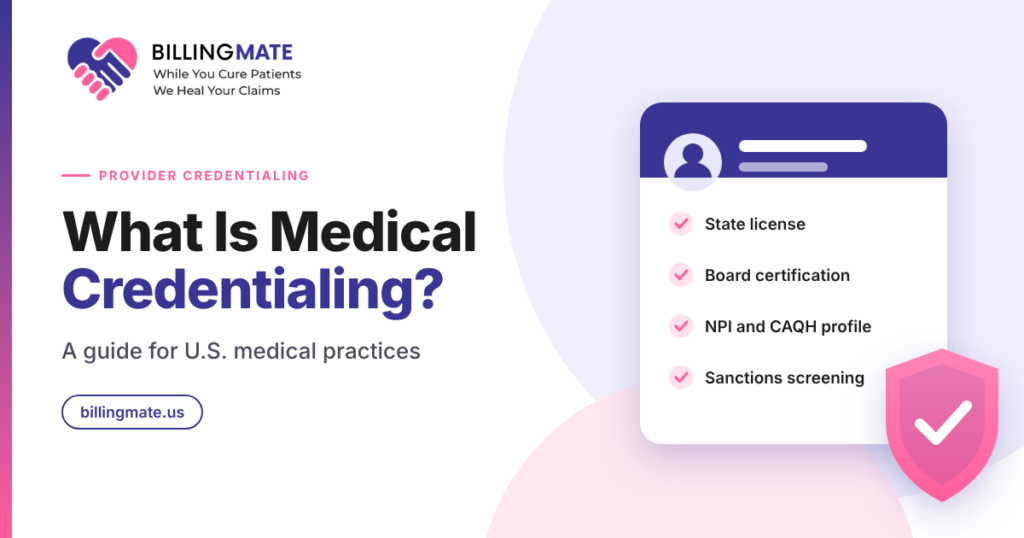
Medical credentialing is the process of verifying a healthcare provider’s qualifications, including education, training, state licensure, board certification, work history, and professional standing, before a hospital, health plan, or practice allows that provider to treat patients or participate in its network. It is repeated on a regular cycle rather than completed once.
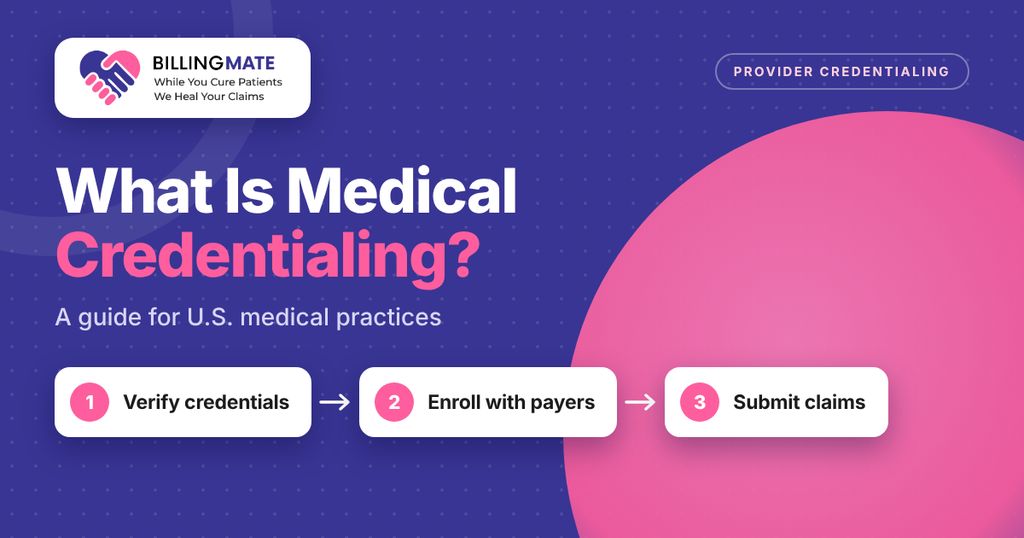
For a U.S. medical practice, credentialing is also tied directly to revenue. Payers generally expect in-network providers to be credentialed before they pay claims, so the status of each provider’s file affects when billing can start. That is why credentialing sits next to eligibility verification, coding and claim submission in a healthy revenue cycle, and why many practices rely on provider credentialing services instead of tracking it on a spreadsheet.
Who Gets Credentialed?
Physician credentialing is the most familiar example, but the same process applies to nurse practitioners, physician assistants, behavioral health clinicians, physical therapists, and other licensed providers who bill payers. Facilities such as clinics and labs go through related verification and enrollment steps. Whether the provider is a new hire, a locum, or an owner adding a second location, credentialing follows the person and often the practice location too.
Why Does Medical Credentialing Matter for a Practice?
Credentialing protects patients, the practice, and the revenue cycle at the same time.
Revenue. A provider who isn’t yet credentialed and enrolled with a payer may not be able to bill that payer as an in-network provider. Claims submitted too early can be denied or pended, and every reworked claim adds to days in A/R. When that happens, the problem lands on your medical billing services team as denials and aging accounts receivable, even though the cause is upstream.
Compliance and patient safety. Credentialing is how organizations confirm that a provider holds the licenses and training they claim and has no disqualifying history. Screening typically includes the HHS Office of Inspector General’s List of Excluded Individuals/Entities, which OIG refreshes monthly, and may include the National Practitioner Data Bank, a confidential clearinghouse created by Congress to support health care quality and reduce fraud and abuse.
Operations and contracts. Credentialing files expire. One payer, Priority Health, has told providers that CAQH re-attestation is required every 120 days and that missing it can prevent recredentialing and put a contract at risk. Rules differ by payer, but the lesson applies broadly: a lapse in paperwork can become a lapse in network participation. Keeping those relationships healthy over time is part of payer contract management.
Credentialing vs. Payer Enrollment vs. Privileging: What’s the Difference?
These three terms are often used interchangeably, but they are separate processes with different owners and different outcomes.
| Process | What it does | Who is involved | What it unlocks |
| Credentialing | Verifies education, licensure, certification, work history and sanctions | Health plans, hospitals, credentialing verification organizations, the practice | Eligibility to be considered for a network or medical staff |
| Payer enrollment | Registers the provider and practice with a payer so claims can be submitted and paid | The provider or practice and each payer, including Medicare through PECOS | An effective date to bill that payer |
| Privileging | Grants permission to perform specific clinical services within a facility | Hospital or facility medical staff and governing body | The right to deliver defined procedures at that facility |
Two practical points follow. First, a National Provider Identifier (NPI) is required for Medicare enrollment but does not replace it. According to the CMS NPI fact sheet, providers must report NPPES changes within 30 days, and updating NPPES does not automatically update Medicare enrollment records.
Second, finishing credentialing with one payer does not mean enrollment is finished with another. People also use the phrase insurance credentialing to describe credentialing and payer enrollment together, and treating them as one project is usually sensible as long as someone tracks each payer’s effective date. Groups operating in several states face extra licensing and payer-specific steps, which we cover in our guide to multi-state credentialing.
How Does the Medical Credentialing Process Work?
Credentialing follows the same basic sequence at most payers and facilities, though forms, portals and timelines differ.
The Steps From Application to Approval
- Gather provider data. Collect the CV, state license numbers, DEA registration if applicable, board certification, malpractice coverage and history, a work history with any gaps explained, and the provider’s NPI.
- Complete the CAQH profile. Many payers pull provider data from the CAQH ProView profile, so the practice completes it, authorizes the right players to view it, and attests that it is accurate.
- Complete primary source verification. The credentialing organization confirms credentials directly with the issuing source, such as the state licensing board or training program, rather than relying on copies. Under NCQA’s credentialing standards, for example, organizations verify a practitioner’s license, medical education, sanction history and prior malpractice cases before the practitioner joins a network.
- Screen for exclusions and sanctions. The organization checks exclusion lists and may query the National Practitioner Data Bank.
- Committee review. A credentialing committee reviews the file and approves it, asks for more information, or denies it.
- Contracting and loading. For a payer, an approved provider is enrolled, given an effective date, and loaded into the payer’s directory and claims system. Get that date in writing before scheduling that payer’s patients with the new provider.
- Ongoing monitoring. Expirations, attestations and recredentialing dates are tracked from here on.
How Long Does Medical Credentialing Take, and What Slows It Down?
Timelines vary by payer, state and the completeness of the application, so no one can promise a fixed number of days. Practices commonly plan for several months, which is why credentialing should start well before a provider’s first day.
Common Causes of Delay
- Incomplete or inconsistent applications, such as a practice address that differs between CAQH, NPPES and the payer application
- A CAQH profile that has not been re-attested or does not authorize the right payer
- Expired or soon-to-expire licenses, DEA registrations or malpractice certificates
- Unexplained gaps in work history
- NPPES records that were not updated after a change
- No clear owner for follow-up, so applications sit in a payer queue
Three Clocks to Track After Approval
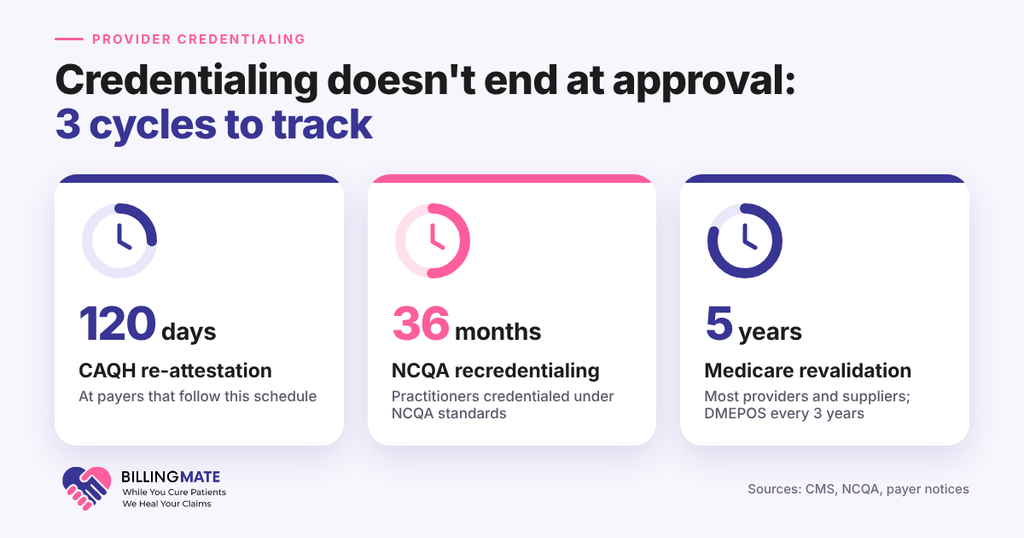
Approval is not the finish line. Three separate cycles keep a provider’s file current:
- CAQH re-attestation: every 120 days at payers that follow that schedule, as in the Priority Health notice cited above.
- NCQA recredentialing: every 36 months for practitioners credentialed under NCQA standards.
- Medicare revalidation: every five years for most providers and suppliers, and every three years for DMEPOS suppliers, done through PECOS. According to the CMS revalidation guidance, missing it can lead to held payments or deactivated billing privileges, and Medicare will not pay for services furnished while a provider is deactivated.
Should a Practice Handle Credentialing In-House or Outsource It?
Either can work. The right choice depends on how many providers you credential, how many payers you bill, and whether someone on staff has time to follow up consistently.
In-house credentialing suits small practices with few providers and payers and a staff member who knows each payer portal. The risk is dependence on one person: if they are out, deadlines slip.
Outsourcing makes more sense when onboarding is frequent, when the group spans several states, or when credentialing keeps competing with front-desk and billing work. BillingMate’s credentialing services cover enrollment, revalidation and CAQH upkeep, which keeps credentialing status connected to the claims your billing team submits.
A Practical Credentialing Checklist
- Start credentialing as soon as a hire is confirmed, not on the start date.
- Keep a master file of each provider’s license, DEA, board certification and malpractice documents, with expiration dates.
- Assign one owner for CAQH and set reminders ahead of every re-attestation.
- Keep addresses, taxonomy codes and group NPI information consistent across CAQH, NPPES, PECOS and payer applications.
- Log every application with the submission date, payer reference number, follow-up date and effective date.
- Confirm effective dates in writing before scheduling a payer’s patients with a new provider.
- Review credentialing status during your monthly denial review, so credentialing-related denials get traced to their source.
Medical Credentialing FAQs
What is medical credentialing in simple terms?
Medical credentialing is the verification of a provider’s qualifications, including license, education, training, certification and history, before a hospital, health plan or practice approves them. It is repeated on a regular cycle.
Is medical credentialing the same as insurance credentialing or payer enrollment?
Not exactly. Credentialing verifies qualifications, while payer enrollment registers the provider with a payer so claims can be paid. Insurance credentialing usually refers to both steps together. A provider needs both completed with each payer before billing it as in-network.
How long does credentialing take?
It varies by payer, state and how complete the application is. Practices commonly plan for several months, so start before the provider’s first day and track each payer’s effective date.
How often do providers need to be recredentialed?
NCQA’s credentialing standards call for recredentialing every 36 months. Separately, many payers expect CAQH re-attestation every 120 days, and Medicare requires most providers to revalidate every five years.
What is CAQH ProView used for?
It is an online profile that many payers use to collect and verify provider data for credentialing. Providers attest to its accuracy on a recurring schedule, and an out-of-date profile can hold up approvals or recredentialing.
Can a provider bill before credentialing is finished?
It depends on the payer. In general, a provider should not bill a payer as in-network until the effective date is confirmed, and some payers may not backdate it. Check each payer’s policy rather than assuming a retroactive date.
Getting Credentialing Right Before It Costs You Revenue
Medical credentialing verifies who a provider is and what they are qualified to do. Payer enrollment, privileging and the recurring CAQH, NCQA and Medicare cycles each add their own deadlines, and a missed one can surface later as denials, a delayed first claim, or a lost network contract. The practical fix is unglamorous: start early, keep one accurate source of provider data, assign an owner, and confirm effective dates in writing.
If your team is stretched, or you are adding providers or states, BillingMate can help. We handle credentialing alongside billing so approvals and claims stay in sync. Contact BillingMate to talk through your current credentialing workload.