
Below is the rewritten version. I removed Medallion/vendor-centric promotion and converted the piece into a BillingMate-focused, U.S.-targeted provider credentialing article, while preserving the strongest multi-state credentialing concepts from the source: state-by-state licensing differences, payer enrollment complexity, provider-data consistency, and parallel credentialing workflows. Pasted markdown
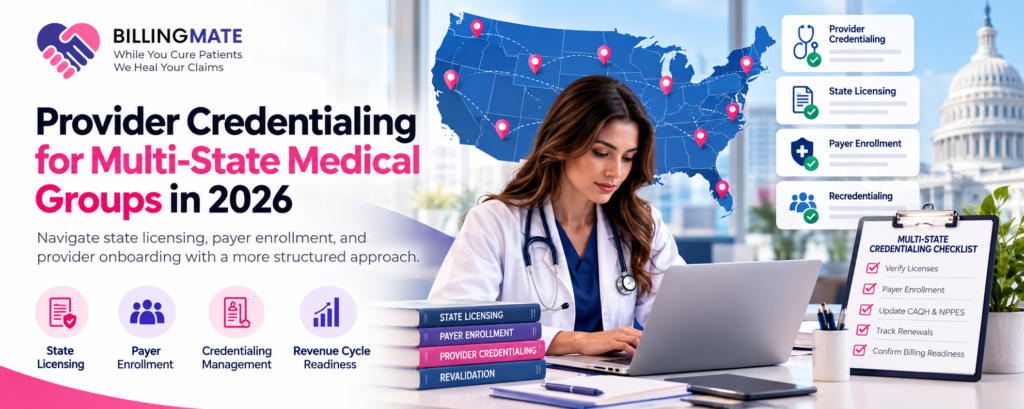
Provider Credentialing for Multi-State Medical Groups in 2026
Expanding a medical practice across multiple U.S. states creates more than a larger credentialing workload. It creates a different operational problem.
Every state can have its own medical board, licensing requirements, renewal cycles, payer mix, enrollment processes, and credentialing timelines. A workflow that works smoothly for a provider practicing in one state can become difficult to manage when the same organization expands into several jurisdictions.
For multi-state healthcare organizations, provider credentialing therefore needs to connect licensing, payer enrollment, provider-data management, renewal tracking, and billing readiness.
BillingMate helps medical practices manage these processes through structured provider credentialing services designed to support provider onboarding and revenue-cycle operations.
Why Multi-State Provider Credentialing Is More Complex
A provider group operating in one state generally manages one primary licensing environment and a relatively predictable payer structure.
As additional states are added, several processes begin running simultaneously.
A provider may need:
- A separate professional license in each applicable state
- State-specific payer enrollment
- Updated NPPES information
- CAQH profile maintenance
- Medicare or Medicaid enrollment updates
- Commercial payer applications
- Recredentialing and renewal tracking
- Practice-location updates
- Provider data synchronized across multiple systems
Even when an interstate licensing pathway simplifies part of the process, credentialing and payer enrollment still require careful tracking.
The challenge is not simply completing more applications.
The challenge is keeping dozens of parallel processes accurate and moving at the same time. The uploaded competitor article makes the same distinction: multi-state credentialing involves licensing, payer enrollment, and provider-data accuracy across multiple jurisdictions rather than merely scaling a single-state workflow. Pasted markdown
Start With Accurate Provider Data
Provider credentialing becomes difficult when different systems contain different versions of the same information.
For example:
- HR records may contain one address
- NPPES may contain an older practice location
- CAQH may contain different contact information
- A payer application may list another taxonomy
- Billing software may still reference a previous group affiliation
These inconsistencies can create application delays and unnecessary follow-up.
A stronger credentialing workflow begins with one accurate provider profile.
This profile should include:
- Legal name
- NPI
- Taxonomy
- Professional licenses
- DEA information where applicable
- Board certifications
- Education and training
- Work history
- Practice locations
- Group affiliations
- Contact details
- Payer participation information
Provider information should then remain consistent across credentialing, enrollment, and billing systems.
Multi-State Licensing Needs Structured Tracking
Licensing requirements can vary significantly from one state to another.
A provider expanding into several states may have applications moving through different medical boards at different speeds.
Without structured tracking, it becomes difficult to answer simple operational questions:
- Which licenses are approved?
- Which are still pending?
- Which documents are missing?
- Which licenses are approaching expiration?
- Which state requires another action?
- Which provider is ready to begin seeing patients?
A centralized tracker should show the status of every license and credentialing requirement.
For growing practices, this becomes increasingly important as more providers and jurisdictions are added.
Payer Enrollment Is Separate From Credentialing
One of the most important distinctions in provider onboarding is the difference between credentialing and payer enrollment.
Credentialing generally verifies that a provider meets professional and organizational requirements.
Payer enrollment establishes the provider within a payer’s system so claims can be billed according to that payer’s requirements.
A provider can therefore be professionally credentialed but still not be ready to submit claims to a specific payer.
This distinction becomes even more important across multiple states because payer requirements can vary by jurisdiction.
BillingMate’s provider credentialing services can support practices with application organization, payer enrollment tracking, follow-up, and provider-data management.
Why Credentialing Delays Affect Medical Billing
Credentialing is not separate from the revenue cycle.
Consider a physician who has already started seeing patients while enrollment with one or more payers remains incomplete.
Clinical operations may appear normal, but the billing team may encounter:
- Provider-not-enrolled rejections
- Incorrect billing relationships
- Location mismatches
- Payer participation problems
- Claim delays
- Additional documentation requests
- Rework after services have already been delivered
This is why credentialing status should be visible to billing teams.
The process should connect:
Provider Onboarding → Credentialing → Payer Enrollment → Billing Activation → Claims
BillingMate’s broader medical billing services help connect provider readiness with claim submission and revenue-cycle operations.
Credentialing Should Begin Before the Provider Start Date
Waiting until the provider’s first day to begin credentialing creates unnecessary risk.
Credentialing should begin as early as practical once the necessary provider information becomes available.
A stronger onboarding workflow includes:
- Collect provider information
- Verify licenses and credentials
- Identify required payers
- Review practice locations
- Prepare applications
- Submit enrollment requests
- Track payer responses
- Resolve missing information
- Confirm effective dates
- Notify billing operations
The objective is not simply to submit paperwork.
The objective is to know exactly when the provider is ready to participate and bill.
Maintain CAQH and NPPES Information
Provider information changes over time.
Addresses change. New locations open. Taxonomies are updated. Contact details change. Providers join new organizations.
These updates may need to be reflected across systems such as CAQH, NPPES, payer portals, Medicare enrollment records, and internal billing software.
Inconsistent provider data can create problems long after initial credentialing is completed.
Practices should therefore include provider-data maintenance as part of ongoing credentialing operations.
Monitor Recredentialing and Expirations
Provider credentialing is not a one-time project.
Licenses expire.
Professional certifications renew.
Payers may require recredentialing.
Enrollment information may need revalidation.
Practices should maintain a structured calendar or tracking system for:
- License expiration dates
- CAQH re-attestation
- Credentialing renewals
- Payer recredentialing
- Medicare revalidation
- DEA expiration
- Professional certifications
- Malpractice insurance documentation
Waiting until an expiration occurs can create avoidable operational disruption.
Connect Credentialing With Revenue Cycle Management
Credentialing data should flow into revenue-cycle operations.
For example, the billing team should know:
- Whether the provider is active with a payer
- Effective participation date
- Approved location
- Billing relationship
- Group affiliation
- Enrollment status
- Outstanding credentialing issue
Likewise, credentialing teams should receive feedback from billing when claims identify provider-related problems.
A useful workflow looks like:
Credentialing → Enrollment → Billing → Claim Response → Credentialing Review
This feedback loop helps practices determine whether a claim problem is related to coding, payer rules, or provider enrollment.
For billing-related support beyond credentialing, BillingMate also provides medical coding services and broader revenue-cycle support.
Track Every Application Through Completion
Submission should never be treated as completion.
Every credentialing or enrollment application should have a defined:
- Provider
- Payer
- State
- Application type
- Submission date
- Reference number
- Current status
- Missing documentation
- Last follow-up date
- Next action
- Effective date
- Assigned owner
This provides accountability.
Without structured follow-up, applications can remain pending for weeks because nobody knows the next required action.
Do Not Assume One Payer Approval Means Credentialing Is Complete
A provider may be enrolled with Medicare but still pending with a commercial payer.
Another payer may approve the provider for one location but not another.
Credentialing status therefore needs to be evaluated payer by payer and location by location.
For multi-state groups, it may also need to be evaluated state by state.
This makes a simple “credentialed/not credentialed” status inadequate for many healthcare organizations.
Common Provider Credentialing Problems
Common operational problems include:
Incomplete provider information
Missing documents or inconsistent demographic information can slow application processing.
Incorrect practice locations
Payer records and provider enrollment information should accurately reflect applicable service locations.
Outdated CAQH information
Old employment, address, insurance, or credential information can create verification issues.
Missing follow-up
Applications may remain pending because additional information was requested but not submitted.
License expiration
Expired credentials can disrupt participation or enrollment.
Payer enrollment started too late
Late onboarding may create a gap between the provider’s clinical start date and billing readiness.
Provider-data inconsistencies
Different information across CAQH, NPPES, payer portals, and internal systems can create unnecessary delays.
Credentialing Checklist for Multi-State Provider Groups
Provider Information
- Confirm legal name
- Verify NPI
- Confirm taxonomy
- Verify licenses
- Review board certifications
- Confirm education and training
- Review work history
- Confirm malpractice insurance
- Verify practice locations
Enrollment
- Identify applicable payers
- Determine state-specific requirements
- Prepare payer applications
- Submit supporting documentation
- Record submission dates
- Track reference numbers
- Monitor application status
- Respond to payer requests
Provider Data
- Review CAQH
- Review NPPES
- Confirm practice addresses
- Verify payer records
- Confirm group affiliations
- Correct inconsistent information
Ongoing Maintenance
- Monitor license expirations
- Track recredentialing
- Monitor revalidation
- Review payer updates
- Maintain CAQH attestations
- Update provider information after operational changes
How Medical Practices Can Improve Credentialing Efficiency
Technology can help, but the process still needs strong operational controls.
The most important improvements are usually straightforward:
Centralize provider information
Avoid storing critical provider data across multiple disconnected spreadsheets and inboxes.
Assign ownership
Every open application should have a responsible team member.
Establish follow-up dates
Do not wait indefinitely for payer responses.
Track effective dates
Submission date and approval date are not the same thing.
Connect credentialing with billing
Billing teams should know which providers are ready to submit claims.
Review recurring problems
If the same payer repeatedly requests corrections, investigate the root cause.
When Should a Practice Consider Credentialing Support?
External credentialing support may be useful when a practice is:
- Hiring multiple providers
- Expanding into new states
- Opening additional locations
- Managing many payer applications
- Experiencing credentialing backlogs
- Missing recredentialing deadlines
- Spending excessive administrative time on payer follow-up
- Encountering provider-enrollment claim issues
Credentialing becomes especially difficult when the organization is growing faster than its administrative infrastructure.
How BillingMate Supports Provider Credentialing
BillingMate provides provider credentialing services for U.S. healthcare organizations that need a structured approach to provider onboarding and payer enrollment.
The process can support:
- Provider information organization
- Credentialing application preparation
- Payer enrollment
- Application tracking
- Follow-up
- Credential maintenance
- Recredentialing support
- Enrollment-status monitoring
- Coordination with billing operations
Credentialing also works best when it is integrated with the rest of the revenue cycle.
BillingMate supports healthcare practices through medical billing services, medical coding services, billing audits, denial management, A/R follow-up, eligibility verification, and related revenue-cycle functions.
What to Look for in a Multi-State Credentialing Workflow
A practice evaluating its current credentialing process should ask:
- Can we see every provider’s licensing status?
- Can we see payer enrollment status by state?
- Are provider records consistent across systems?
- Are renewal dates tracked automatically or manually?
- Does every application have an owner?
- Are follow-ups scheduled?
- Does billing know when providers become active?
- Can we identify applications that have stalled?
The uploaded source similarly emphasizes multi-state licensing, payer enrollment across states, provider-data integration, automation with human review, and ability to scale as core evaluation criteria. Pasted markdown
If Your Medical Group Is Expanding Across States
Multi-state growth creates opportunities, but provider credentialing can quickly become an operational bottleneck if licensing, payer enrollment, and provider information are managed independently.
A stronger approach centralizes the process.
BillingMate can help medical practices manage provider credentialing while connecting enrollment activity with the wider billing workflow.
Learn more about BillingMate’s Provider Credentialing Services
Frequently Asked Questions
How does provider credentialing work across multiple states?
Providers generally need to satisfy applicable licensing, credentialing, and payer-enrollment requirements for every jurisdiction where they practice.
Multi-state organizations therefore manage several parallel processes rather than one national credentialing application.
Is credentialing the same as payer enrollment?
No.
Credentialing verifies the provider’s qualifications and professional information.
Payer enrollment establishes the provider with a specific payer so claims can be submitted according to that payer’s requirements.
Can a provider have an NPI but still not be credentialed?
Yes.
An NPI identifies the provider but does not itself confirm payer credentialing or enrollment.
Can a provider be credentialed but unable to bill a payer?
Yes.
Credentialing and payer enrollment are separate processes. A provider may satisfy credentialing requirements while payer enrollment remains incomplete.
Why does provider credentialing affect revenue?
If provider enrollment is incomplete or incorrect, claims may be rejected, delayed, or require additional administrative work.
This is why credentialing should be connected with medical billing services rather than managed as an isolated administrative process.
How long does provider credentialing take?
There is no universal timeline.
Processing can vary based on provider type, state, licensing board, payer, application completeness, and whether additional documentation is requested. The source article also notes that timelines can differ significantly between jurisdictions and payers. Pasted markdown

Final Takeaway
Multi-state provider credentialing in 2026 requires more than submitting applications.
Healthcare organizations need to manage:
Licensing → Provider Data → Credentialing → Payer Enrollment → Follow-Up → Billing Activation → Maintenance → Recredentialing
The more states and providers an organization adds, the more important structured tracking becomes.
BillingMate helps U.S. healthcare practices manage provider credentialing alongside medical billing, coding, denial management, A/R follow-up, and other revenue-cycle functions.
A connected credentialing and billing workflow helps practices identify provider-enrollment problems earlier, reduce unnecessary administrative rework, and create better visibility into when providers are ready to participate and bill.